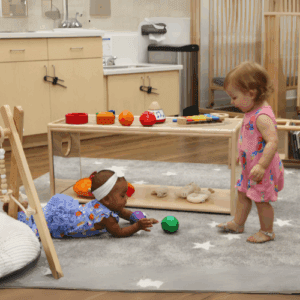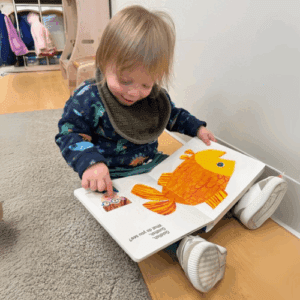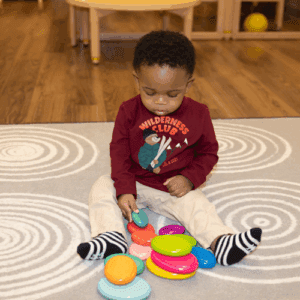
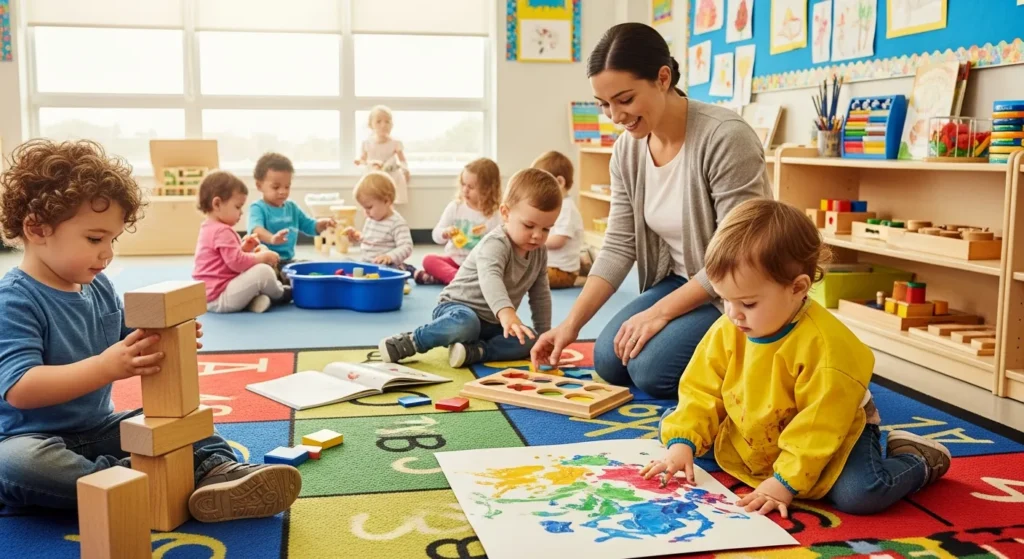
Every moment of a toddler’s day holds a chance to learn. From stacking blocks to singing silly songs, early childhood education activities build the foundation for lifelong skills like problem-solving, communication, and self-regulation. Whether you’re a parent looking for ideas at home or an educator planning your curriculum, the right activities can turn everyday routines into powerful learning experiences.
Schedule a tour at Strong Start Early Care & Education to see how our toddler classrooms use hands-on activities to support every area of your child’s development.
Why Early Childhood Education Activities Matter
Research consistently shows that the first five years of life are a critical window for brain development. During this period, children form more than one million neural connections every second, according to the Center on the Developing Child at Harvard University. Structured, age-appropriate activities help strengthen these connections and lay the groundwork for academic and social success.
High-quality early childhood education activities do more than keep toddlers busy. They support development across four key domains:
- Cognitive development: Activities that involve sorting, counting, and pattern recognition build early math and reasoning skills.
- Language and communication: Songs, storytelling, and conversation during play expand vocabulary and comprehension.
- Social-emotional growth: Cooperative games and group activities teach sharing, empathy, and emotional regulation.
- Physical development: Both fine motor activities (like drawing) and gross motor play (like climbing) strengthen coordination and body awareness.
The best part? These learning opportunities don’t require expensive materials. Many of the most effective toddler learning activities use simple household items and everyday interactions.
Sensory Play Activities for Toddlers
Sensory play is one of the most valuable types of early childhood education activities for toddlers aged 1 to 3. It engages multiple senses at once and helps children make sense of the world around them. Sensory experiences also support language development as children describe textures, temperatures, and colors.
Water and Sand Tables
Fill a shallow bin with water, sand, or rice and add scoops, cups, and funnels. Toddlers practice pouring, measuring, and comparing volumes while building early math concepts. Add food coloring to water for color-mixing experiments that introduce basic science.
Playdough Creations
Homemade or store-bought playdough strengthens fine motor muscles that toddlers need for writing later on. Encourage children to roll, pinch, flatten, and cut shapes. Add cookie cutters, plastic knives, and textured rollers to extend the learning.
Sensory Bins
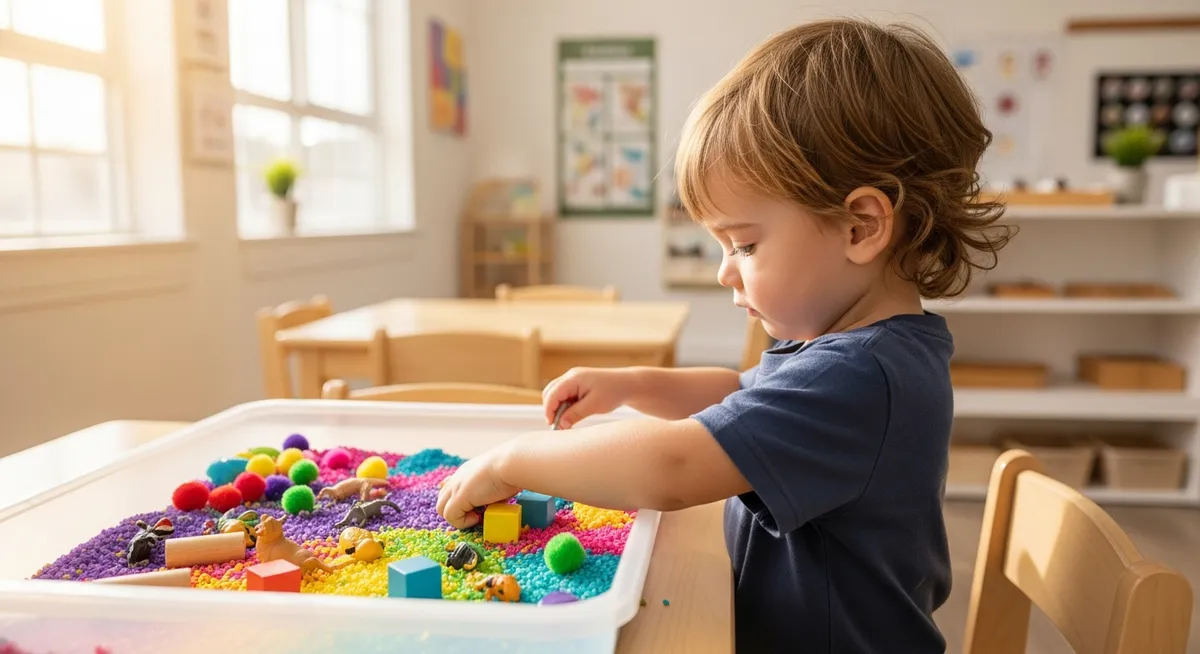
Create themed sensory bins using dried pasta, cotton balls, or shredded paper. Hide small toys inside and ask toddlers to find and name them. This simple activity builds vocabulary, fine motor skills, and concentration at the same time.
Creative Arts and Expression Activities
Art activities give toddlers a way to express themselves before they have the words to do so. Process-focused art, where the experience matters more than the final product, is ideal for this age group.
Finger Painting
Finger painting lets toddlers explore color, texture, and cause-and-effect. Use washable, non-toxic paints on large sheets of paper or even directly on a table surface. Talk about the colors they’re mixing and the shapes they’re making to build descriptive vocabulary.
Collage Making
Tearing paper, gluing fabric scraps, and arranging stickers all develop fine motor control. Collage projects also introduce concepts like spatial awareness and categorization. Offer a variety of materials in different textures and let children make their own creative choices.
Music and Movement
Singing songs, clapping rhythms, and dancing to music develop auditory processing, coordination, and memory. Simple instruments like shakers and drums let toddlers experiment with sound. Musical activities are especially effective for social-emotional learning because they encourage group participation and self-expression.
Language and Literacy Activities
Language skills develop rapidly between ages 1 and 4. Early literacy activities don’t just prepare children for reading; they build the communication skills that toddlers need for every social interaction.
Read-Aloud Sessions
Daily read-aloud time is one of the most impactful educational activities for toddlers. Choose books with repetitive phrases, bright illustrations, and interactive elements like flaps or textures. Pause to ask questions: “What do you think happens next?” or “Can you point to the dog?”
Storytelling With Props
Use puppets, felt boards, or small figurines to retell familiar stories. This activity strengthens narrative understanding, sequencing, and imaginative thinking. Eventually, toddlers begin creating their own stories, which is a major milestone in language development.
Labeling the Environment
Place word labels on common objects around the classroom or home: “door,” “window,” “chair.” Point to and read labels during daily routines. This simple strategy builds print awareness and helps toddlers connect spoken words with written text.
Math and Problem-Solving Activities
Toddlers are natural mathematicians. They sort, compare, and count without even realizing it. Intentional math activities build on this instinct and prepare children for more complex thinking in preschool and kindergarten.
Sorting and Classifying
Give toddlers a collection of objects in different shapes, sizes, or colors and ask them to group them. Use buttons, pom poms, blocks, or even socks from the laundry. Sorting teaches categorization, a foundational skill for both math and science.
Block Building
Stacking and building with blocks develops spatial reasoning, balance, and early engineering concepts. Ask questions like “How tall can you build it?” or “What happens if you put the big block on top?” to encourage experimentation and critical thinking.
Simple Puzzles
Age-appropriate puzzles with large knobs or chunky pieces build problem-solving skills and hand-eye coordination. Start with 2-3 piece puzzles for younger toddlers and gradually increase complexity. Puzzles also teach persistence and the satisfaction of completing a task.
Gross Motor and Outdoor Activities
Physical activity is essential for healthy development, and outdoor play provides unique learning opportunities that indoor environments can’t replicate. Active play strengthens muscles, builds coordination, and supports emotional regulation. At quality early learning programs for toddlers, outdoor time is a structured part of the daily schedule.
Obstacle Courses
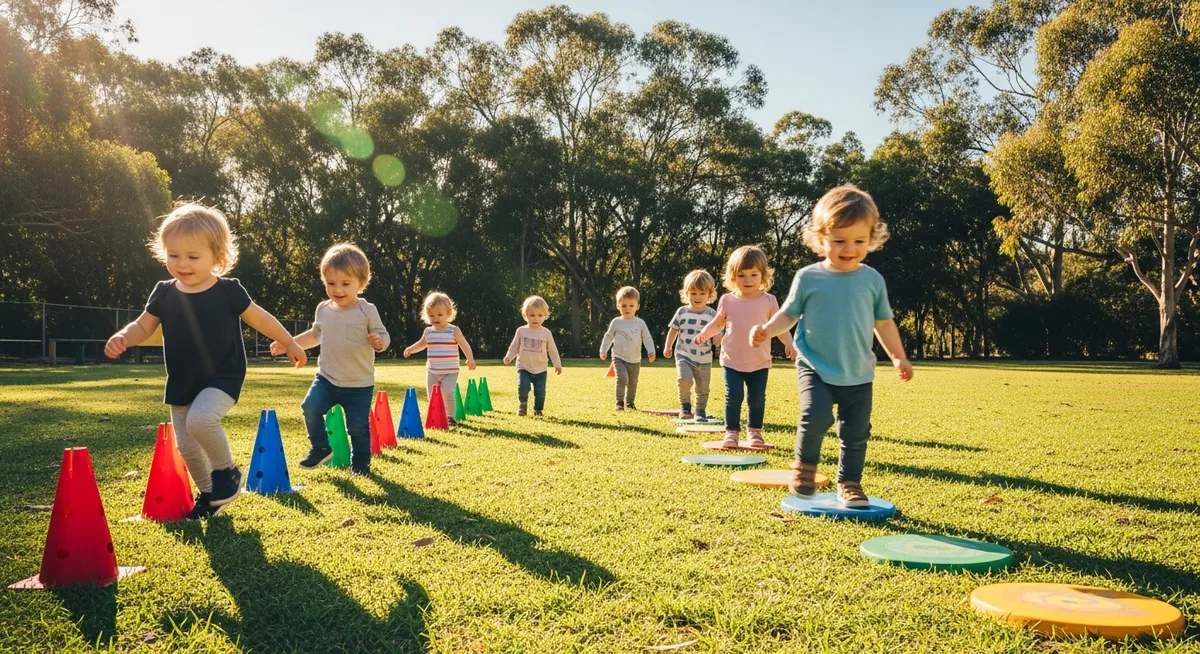
Set up a simple obstacle course using pillows, tunnels, and stepping stones. Crawling, climbing, balancing, and jumping develop gross motor skills while building confidence. Add directional instructions like “go under,” “step over,” and “walk around” to build spatial vocabulary.
Nature Walks and Scavenger Hunts
Take toddlers on a nature walk and encourage them to collect leaves, rocks, or flowers. Use a simple picture checklist for a scavenger hunt. These activities build observation skills, vocabulary (colors, shapes, sizes), and an appreciation for the natural world.
Ball Games
Rolling, throwing, catching, and kicking balls develops hand-eye coordination and introduces concepts like force, direction, and distance. Group ball games teach turn-taking and cooperation, key social skills for toddlers preparing for kindergarten readiness programs.
Social-Emotional Learning Activities
Toddlers are just beginning to understand their emotions and learn how to interact with others. Social-emotional learning activities help children develop empathy, self-awareness, and relationship skills that serve them throughout life.
Emotion Identification Games
Use picture cards or a mirror to help toddlers identify different facial expressions. Ask “How does this person feel?” and practice making happy, sad, surprised, and angry faces. This builds emotional vocabulary and helps children recognize feelings in themselves and others.
Cooperative Play Activities
Set up activities that require two or more children to work together, like building a block tower or completing a puzzle. Guided cooperative play teaches negotiation, sharing, and the value of teamwork. These are skills that children develop best in a child-centered learning environment.
Dramatic Play
Set up a pretend kitchen, doctor’s office, or grocery store. Dramatic play lets toddlers practice real-world scenarios in a safe space, developing language, social skills, and emotional processing. It also encourages perspective-taking as children “become” different characters.
How to Implement These Activities at Home
You don’t need a classroom to provide quality early childhood education activities. Here are practical tips for parents:
- Follow your child’s lead: Observe what interests your toddler and build activities around those interests. A child fascinated by cars might enjoy sorting toy vehicles by color or counting wheels.
- Keep it short: Toddlers have limited attention spans. Five to fifteen minutes per activity is plenty. Rotate activities frequently to keep engagement high.
- Embrace the mess: Sensory play and art projects are supposed to be messy. Put down a drop cloth or take activities outside, and let your child explore freely.
- Talk through everything: Narrate what you’re doing, ask open-ended questions, and expand on your child’s words. Everyday conversations are one of the most powerful child-led learning strategies available.
- Create a routine: Build activity time into your daily schedule. Consistent routines help toddlers feel secure and ready to learn.
Ready to give your toddler the best start? Schedule a tour at Strong Start Early Care & Education and see our play-based curriculum in action.
Frequently Asked Questions
What are the best early childhood education activities for 2-year-olds?
The best activities for 2-year-olds focus on sensory exploration and simple problem-solving. Water play, playdough, finger painting, block stacking, and read-aloud sessions are all excellent choices. At this age, keep activities open-ended and focus on the process rather than a finished product. Activities that involve naming colors, shapes, and objects also support the rapid language development happening at age 2.
How do early childhood activities support kindergarten readiness?
Early childhood education activities build the foundational skills that children need to succeed in kindergarten, including following directions, recognizing letters and numbers, using scissors, and cooperating with peers. Activities like sorting, puzzles, and storytelling develop cognitive and language skills, while group play and dramatic play build the social-emotional skills that kindergarten teachers say matter most for school readiness.
How much structured activity time do toddlers need each day?
The National Association for the Education of Young Children (NAEYC) recommends a balanced mix of structured and unstructured play throughout the day. For toddlers, aim for several short activity periods of 10 to 20 minutes each, with plenty of free play in between. Most high-quality childcare programs include 2 to 3 hours of planned activities spread across the day, covering different developmental areas.
What activities help toddlers develop fine motor skills?
Activities that strengthen small hand and finger muscles include playdough manipulation, tearing and gluing paper, stringing large beads, drawing with crayons, and using child-safe scissors. Sensory bins that require picking up small objects with a pincer grasp are also excellent for fine motor development. These skills are essential preparation for writing in preschool and kindergarten.
Can I do early childhood education activities without special materials?
Absolutely. Many of the most effective toddler learning activities use everyday household items. Pots and wooden spoons become musical instruments. Laundry becomes a sorting game. Cardboard boxes transform into buildings or vehicles. The key is interaction and conversation, not expensive supplies. Talking with your child, asking questions, and following their curiosity are the most important elements of any educational activity.
Early childhood education activities are the building blocks of your toddler’s future academic and social success. Whether you choose sensory play, creative arts, language games, or outdoor adventures, the most important thing is consistent, engaged interaction with your child. At Strong Start Early Care & Education, our experienced educators design every day around purposeful, play-based learning activities that support every area of development. Contact us today to learn more about our toddler and preschool programs in Trumbull, Shelton, and Wilton, CT.