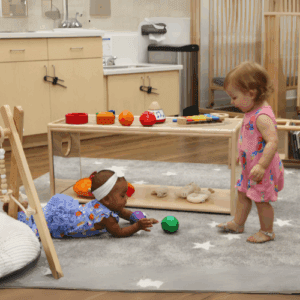
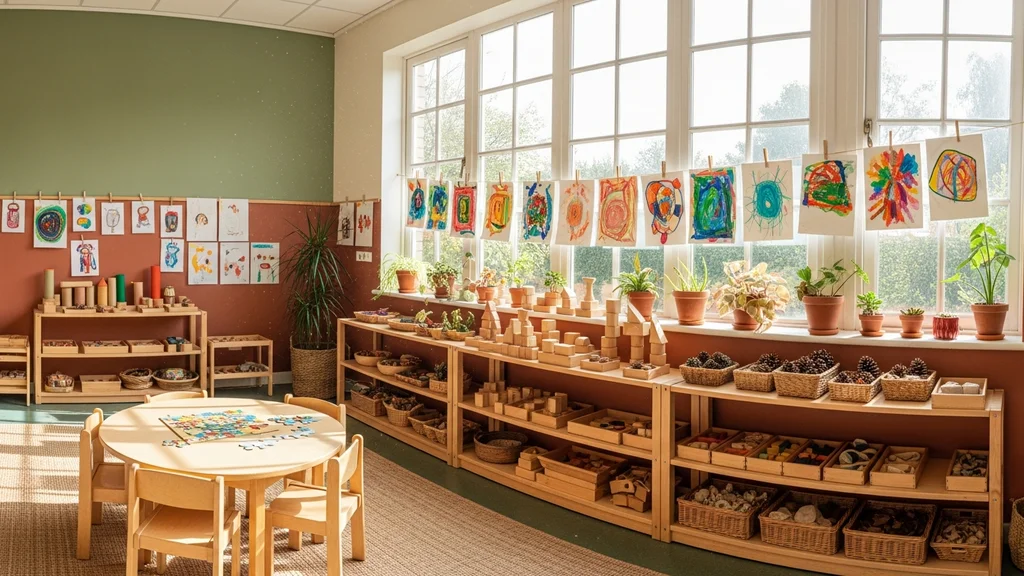
When you step into a Reggio Emilia classroom, you feel the difference immediately. The light is softer. The shelves hold pinecones and wooden blocks instead of just plastic toys. This unique reggio emilia classroom environment is built entirely for the child. The walls are covered not in store-bought posters but in photos of children at work, with handwritten notes capturing what they said and thought. This is the heart of the Reggio Emilia approach. Every element of the reggio classroom design sends a clear message: your work is important, and your voice is heard here.
Parents who tour a Reggio Emilia-inspired classroom often say they expected a classroom and found a studio. This guide walks you through exactly what you will see, room by room and shelf by shelf, and explains why each detail matters for your child’s development.
What Defines a Reggio Emilia Classroom?
A Reggio Emilia classroom is an early childhood learning environment built on the principle that the space itself is a teacher. In the Reggio Emilia approach, three forces shape every child’s education: the educator, the family, and the environment. The physical classroom is called the “third teacher,” and it is designed with the same care and intentionality as any lesson plan.
This idea originated in post-WWII northern Italy, where community members rebuilt their schools from the ground up with a shared belief: children are capable, curious, and deserving of beautiful spaces that take their ideas seriously. Today, Reggio Emilia-inspired classrooms around the world share a set of recognizable design features, from the arrangement of furniture to the materials on the shelves to the documentation covering every wall.
The Philosophy Behind the Reggio Emilia Approach
The beautiful, thoughtfully arranged classrooms of the Reggio Emilia approach are not just for show. They are the physical expression of a deep and respectful philosophy about how children learn. This educational method is built on a powerful image of the child: one who is born with immense potential, curiosity, and a desire to connect with the world. Instead of viewing children as empty vessels waiting to be filled with knowledge, this approach sees them as active protagonists in their own learning journey. The entire system—the teachers, the classroom, and the curriculum—is designed to support and follow the child’s lead, nurturing their innate drive to explore, question, and understand.
The Vision of Loris Malaguzzi
After World War II, in the villages around Reggio Emilia, Italy, a teacher named Loris Malaguzzi witnessed a community determined to build a new kind of school for their children. He was inspired by their belief that children deserved an education that respected their intelligence and creativity. Malaguzzi helped shape this vision into a formal approach, centered on the idea that children are naturally curious and learn best by exploring their own interests. He believed education should be a “journey of discovery and research” for both children and teachers, a collaborative process rather than a one-way transmission of facts. This foundational vision is what separates the approach from more traditional models of early education.
The Child as a Capable and Curious Learner
At the heart of the Reggio Emilia philosophy is an unwavering belief in the capability of every child. Children are seen as competent, resourceful, and full of ideas. This approach puts children at the center of their learning, valuing their unique perspectives and trusting them to guide their own educational path. Rather than being told what to learn, children are given the tools and the time to investigate their own questions. This respect for the child’s intellect is why you’ll see long-term, in-depth projects in a Reggio-inspired classroom. At Strong Start, our curriculum is built around this very idea, honoring each child’s unique voice and their incredible capacity for discovery, as reflected in our own Reggio Emilia inspiration.
The Three “Teachers” of Reggio Emilia
In the Reggio Emilia philosophy, a child’s education is not left to a single person. Instead, it’s viewed as a collaborative effort guided by three distinct “teachers.” The first two are the parents and the classroom educators, who work together as partners. The third “teacher” is the environment itself—the physical space of the classroom, which is intentionally designed to provoke curiosity and support learning. This framework ensures that a child is supported by a network of influences that are all working in harmony. It creates a rich, dynamic, and responsive educational experience where learning can happen everywhere and is nurtured by everyone involved in the child’s life.
The First Teacher: Parents as Partners
The Reggio Emilia approach recognizes that a child’s first and most important teachers are their parents. You are the expert on your child. This philosophy places a high value on creating a strong connection between home and school, viewing parents as essential collaborators in the educational process. Teachers actively seek out parents’ insights, observations, and goals for their children, understanding that this partnership is crucial for the child’s success and well-being. This collaborative spirit is a cornerstone of our community at Strong Start, where we are committed to partnering with parents through open communication and shared involvement in their child’s learning journey.
The Second Teacher: The Educator as Co-Learner
In a Reggio-inspired classroom, the teacher’s role is different from what you might expect. They are not simply instructors who deliver a pre-set curriculum. Instead, educators act as researchers, observers, and partners in the learning process alongside the children. Their job is to listen carefully to children’s conversations, observe their play, and document their discoveries to understand their interests and theories about the world. Based on these observations, teachers then provide materials, ask thought-provoking questions, and plan experiences that help children explore their ideas more deeply. This responsive teaching style requires a team of dedicated and highly skilled educators, which is why we place such a high value on our exceptional early childhood professionals.
The Third Teacher: The Environment
The classroom itself is considered the “third teacher.” Every detail of the space is designed with intention to be a welcoming, inspiring, and flexible environment that encourages children to explore, create, and learn. You’ll notice an abundance of natural light, organized and accessible materials, and comfortable spaces that invite both individual focus and group collaboration. The walls are not for decoration but for documentation, displaying photos of the children’s work and transcriptions of their thoughts. This makes their learning visible and valued. The environment acts as a silent but powerful guide, sparking curiosity and supporting the complex, wonderful work of childhood, which you can see in the design of our own preschool classrooms.
First Impressions: A Focus on Light and Natural Materials
Step into a Reggio Emilia classroom and two things hit you right away: the quality of the light and the texture of the materials. Large windows are standard. Natural light is prioritized over fluorescent overhead lighting wherever possible. Teachers may use sheer curtains to soften bright afternoon sun rather than block it out.
On the shelves, you will not find plastic bins full of single-purpose toys. Instead, you will see:
- Baskets of smooth river stones, pinecones, shells, and seed pods
- Wooden blocks in many shapes and sizes
- Lengths of fabric, ribbons, and natural fibers
- Glass jars, small mirrors, and translucent tiles
- Clay, beeswax, and other moldable materials
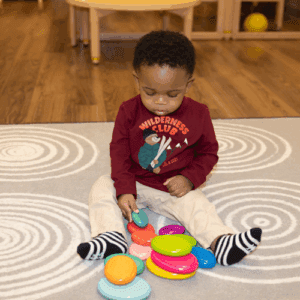
These are called open-ended materials. They do not have one correct use. A child might sort the stones by size, use them to build a garden in a small box, or line them up as a road for toy animals. The material does not dictate the play. The child does.
Open-ended materials support what Reggio Emilia educators call the “hundred languages of children,” the idea that children express and develop understanding through drawing, building, singing, sculpting, moving, and more. Stocking the room with materials that support all of those forms of expression is a deliberate teaching choice.
The Purpose of a Neutral and Calming Palette
The soft, neutral colors in a Reggio Emilia classroom are a deliberate choice. Instead of bright, primary-colored walls and furniture that can be visually overwhelming, the environment uses a calming palette of whites, beiges, and natural wood tones. The purpose is to create a peaceful backdrop that puts the spotlight on what truly matters: the children and their work. Think of the classroom as a gallery and the children as the artists. A neutral setting allows the vibrant colors of their paintings, the intricate details of their block structures, and the textures of their nature collections to stand out. This is a key part of our Reggio Emilia-inspired curriculum; the environment becomes a “third teacher” that supports focus and creativity rather than competing for a child’s attention.
Documentation Walls: Making Children’s Learning Visible
One of the most striking features of a Reggio Emilia classroom is the documentation covering the walls. This is not artwork hung for decoration. It is a living record of children’s thinking.
What you will see on a typical documentation wall:
- Photographs of children mid-investigation, often with close-up shots of their hands at work
- Transcribed quotes from children, printed or handwritten, capturing the questions they asked and the theories they proposed
- Sketches children made while exploring a topic
- A brief description of the inquiry project, explaining what prompted it and where it went
- Evidence of multiple iterations, showing how children returned to an idea and extended it over days or weeks
Documentation is hung at children’s eye level, not adult eye level. This matters. It communicates to children that their work is valued and that their process, not just their finished product, deserves to be seen.
For parents, documentation walls are one of the most immediate ways to understand what your child is learning and how deeply they are engaging with ideas. When you visit a classroom and see a wall dedicated to a four-week investigation into how bridges stay up, you are seeing evidence of the sustained thinking your child is capable of.
How Learning Unfolds: An Emergent Curriculum
In a Reggio Emilia-inspired classroom, you won’t find a rigid, pre-planned curriculum. Instead, learning is a fluid process that emerges directly from the children’s own interests and theories about the world. This is known as an emergent curriculum. It’s a collaborative adventure where teachers and children explore topics together, allowing for deep, meaningful investigations that can last for days or even weeks. This approach is built on a profound respect for children as capable thinkers. Rather than being told what to learn, they are empowered to ask their own questions and construct their own understanding, with the teacher serving as a researcher and guide alongside them. This philosophy is at the heart of how we structure learning, viewing each child as the protagonist of their own educational journey.
Following Children’s Interests
An emergent curriculum begins with careful observation. Teachers are trained to be keen listeners, paying close attention to the conversations, questions, and play that captivate children. When a group of toddlers becomes fascinated by the way rain collects in puddles, that becomes the curriculum. The teacher doesn’t just acknowledge the interest; they actively support and extend it. They might bring in containers to explore volume or read books about weather. This method ensures learning is always relevant because it stems from genuine curiosity. It’s a core component of The Project Approach, where children’s questions spark long-term investigations that build critical thinking and research skills from a very early age.
Using Provocations to Spark Discovery
While the curriculum is child-led, teachers play a vital role in sparking new avenues of discovery. They do this by setting up “provocations”—thoughtfully arranged materials that invite children to explore, experiment, and create. A provocation is not a craft with instructions; it’s an open-ended invitation to think. For instance, if children are building with blocks, a teacher might add small mirrors and ramps to the area, provoking questions about reflection and gravity. These setups are based on observations of the children’s current interests and are designed to stretch their thinking. Through these hands-on experiences, children develop theories and make connections, building a strong foundation for a lifetime of learning in our classrooms.
What Is an Atelier? The Creative Heart of the Classroom
Most Reggio Emilia schools include an atelier, a dedicated art studio. In schools with enough space, this is a separate room staffed by a specialist called an atelierista. In smaller programs, it may be a defined corner of the main classroom.
The atelier is not a place where children are taught to follow art projects with predetermined outcomes. It is a place where children work with materials as a language. They might spend several sessions drawing the same apple from different angles, not because a teacher told them to, but because drawing is how they are thinking through what they are investigating.
An atelier typically contains:
- Watercolors, tempera paint, and drawing materials organized so children can access them independently
- Clay and sculpting tools
- Collage materials including paper in many weights and textures
- Wire, wood scraps, and construction materials for three-dimensional work
- A display of children’s ongoing work in progress
The materials are beautiful. That is intentional. Reggio Emilia educators believe children should work with quality materials that communicate respect for their efforts. A thin crayola crayon and a copy paper sketch pad send a message. So does a real watercolor brush and good drawing paper.
How Light Tables Spark Curiosity and Exploration
A light table is one of the most recognizable pieces of equipment in a Reggio Emilia classroom. It is exactly what it sounds like: a translucent surface with a light source underneath. Children place materials on top and explore what happens.
What you might see a child doing at a light table:
- Arranging colored transparent tiles and discovering that red and blue make purple
- Looking at leaves, feathers, and other natural materials to see their structure
- Using translucent shapes to create patterns and study shadows
- Drawing by tracing the shadows cast by objects placed on the surface
The light table is a sensory and scientific tool. It invites observation, experimentation, and aesthetic play all at once. In a room designed to support the hundred languages, it gives children a way to explore light itself as a material.
Reggio Classroom Design: A Purpose for Every Space
A Reggio Emilia classroom is not one open room where everything happens in the same way. The space is intentionally divided into areas that support different kinds of engagement.
The Piazza: A Central Hub for Community
Inspired by the central squares in Italian towns, many Reggio Emilia classrooms feature a “piazza.” This is a designated open area for the whole class to gather. It’s not just for morning circle time; it’s the social heart of the room. The piazza is where children come together to share ideas, listen to stories, work on large-scale collaborative projects, and build a shared sense of identity as a group. You might see a large rug, comfortable cushions, and low shelving that defines the space without closing it off. This central hub provides a necessary balance to the smaller, more focused learning areas, giving children a place to practice being part of a larger community.
Accessible Materials for Independent Exploration
On the shelves, you will not find plastic bins full of single-purpose toys. Instead, you will see open-ended materials that do not have one correct use. A child might sort stones by size, use them to build a garden in a small box, or line them up as a road for toy animals. Materials are organized in low, open shelving, often in clear containers or wicker baskets, so children can see what is available and access it themselves. This thoughtful organization communicates respect for the child’s ability to make choices and care for their environment. It also supports the Project Approach, where children use a variety of materials to investigate their questions over an extended period.
Co-Creating the Classroom with Children
In a Reggio-inspired classroom, the environment is not static; it evolves with the children. As children engage in projects, their work transforms the space. Documentation is hung at children’s eye level, not adult eye level. This matters. It communicates to children that their work is valued and that their process, not just their finished product, deserves to be seen. You’ll see their drawings, clay sculptures, and transcribed conversations displayed with care. This practice turns the classroom walls into a living narrative of the children’s learning journey, creating a space that reflects their ideas and gives them a true sense of ownership. It’s a powerful way of partnering with children in their own education.
Building Big Ideas: The Construction Area
A large open area with unit blocks, loose parts, and enough floor space for ambitious building. This is where children might spend forty minutes building a marble run or constructing a model of the school parking lot after a class discussion about where buses park.
Fostering a Love for Stories: The Literacy Corner
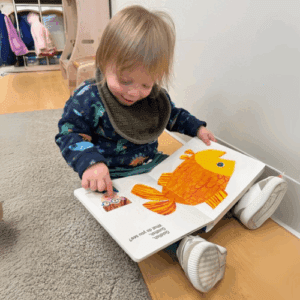
A small, cozy space with floor cushions or a rug, a small shelf of books, and often a basket of materials for writing and mark-making. It is designed to feel like a private retreat, a place to settle in with a story or sit with a friend and work on a shared writing project.
Exploring Our World: The Science and Nature Area
A table or windowsill dedicated to current investigations. This might hold a magnifying glass, a collection of materials related to an ongoing inquiry project, a plant the children are observing as it grows, or a small aquarium. It changes based on what children are currently interested in.
Learning Together: The Small-Group Table
A table sized for four to six children, used for teacher-facilitated small group experiences, sensory exploration, and collaborative projects. In a Reggio Emilia classroom, the teacher rarely addresses the whole group at once. Most learning happens in small clusters where children can talk to each other, not just listen to an adult.
What You Won’t See in a Reggio Emilia Classroom
Understanding what is absent is just as helpful as knowing what is present. A few common sights in traditional classrooms that you will not find in a Reggio-inspired space:
- A teacher’s desk at the front: There is no front of a Reggio classroom. The teacher moves through the space, observing, asking questions, and sitting alongside children rather than standing above them.
- Seasonal bulletin board kits: Purchased decorations with nothing to do with the children in the room. Documentation of this group, this year, replaces generic decor.
- Pre-made art projects: Thirty identical paper turkeys or symmetrical butterflies. In a Reggio classroom, children’s art looks different from each other because each child followed their own ideas.
- Rigid ability groupings or labeled work areas: Centers labeled “Math Station” and “Reading Station” with assigned rotations. Space is organized by type of engagement, not by subject, because in Reggio Emilia thinking, a child building with blocks is doing science, math, and narrative simultaneously.
Bringing the Outdoors In: Connecting Nature and the Classroom
In an authentic Reggio-inspired program, the outdoor environment is treated as an extension of the classroom, not a break from it. Children do not just go outside to run around and come back in. They bring their investigations outdoors.
A group investigating shadows might spend part of a morning outside tracing each other’s shadows on the pavement at different times of day to observe how they change. A group curious about birds might observe feeders, draw what they see, and then bring those drawings back inside to compare with photographs and books.
Outdoor spaces in Reggio-inspired programs tend to include:
- A garden where children plant, tend, and harvest
- Natural loose parts like sticks, rocks, and leaves available for play
- Space for large-scale construction and physical challenge
- Areas that change with the seasons and invite observation over time
Considering the Broader Context
Is the Reggio Emilia Approach Only for Preschoolers?
While the Reggio Emilia philosophy is most famously applied in early childhood settings, its core principles are not limited by age. The belief that learners are capable, curious, and driven to make meaning of their world is a powerful foundation for education at any level. In fact, many educators find that the approach can work for children of all ages, from elementary to high school. The emphasis on long-term projects and collaborative inquiry prepares children for a lifetime of learning by teaching them how to think, not just what to think. At its heart, it’s about fostering a disposition for discovery, a skill that is valuable whether you are three or thirteen. This is why the Project Approach is so integral; it builds a framework for investigation that grows with your child.
The Affordability of Natural and Recycled Materials
When parents see the beautiful, thoughtfully arranged materials in a Reggio-inspired classroom, some wonder about the cost. It’s a fair question. The truth is, this approach is often more affordable than you might think because it prioritizes natural and recycled materials over expensive, single-use toys. A basket of interesting seed pods, a collection of smooth stones, or scraps of beautiful fabric can be sourced for little to no cost, yet they offer infinite possibilities for play and investigation. This isn’t just about being frugal; it’s a philosophical choice. It teaches children to see the potential and beauty in the everyday world around them, fostering creativity and resourcefulness. This focus is a key part of our Reggio Emilia inspiration, reminding us that the best learning tools are often the simplest.
Understanding Common Criticisms
One of the most common questions parents have about the Reggio Emilia approach concerns the curriculum. Without a pre-written, standardized lesson plan for every day, how can you be sure children are learning what they need to know? Some critics have pointed to this lack of a fixed curriculum as a potential weakness, suggesting there is a lack of accountability. However, this view misunderstands how accountability works in a Reggio-inspired school. Learning is not left to chance; it is guided by highly skilled educators who are experts in child development. They meticulously document children’s progress, making learning visible through photos, transcripts, and project displays. Furthermore, high-quality programs adhere to rigorous external standards. For example, achieving NAEYC accreditation requires demonstrating a commitment to excellence across all areas of operation, providing a powerful layer of accountability that ensures every child receives a rich, effective, and well-documented education.
What to Look for on Your Reggio-Inspired School Tour
If you are visiting a preschool that describes itself as Reggio Emilia-inspired, you now have a practical checklist. Here is what to look for as you walk through:
- Natural light: Are windows uncovered or softened? Is the room warm and inviting rather than brightly lit with overhead fluorescents?
- Open-ended materials: Do you see natural and sensory materials on accessible, organized shelves? Or bins of plastic toys children cannot easily use independently?
- Documentation: Are children’s photos, words, and work displayed at their eye level? Can you read the documentation and understand what children have been thinking about?
- An atelier or art studio space: Is there a dedicated area for art as a language, with real materials available to children?
- A light table: Is there a light table or other light-exploration tool in the classroom?
- Multiple defined spaces: Is the room arranged so that different types of engagement are possible at the same time?
- Connection to current projects: Can you see evidence of ongoing investigations that belong to this specific group of children?
A strong Reggio-inspired program will answer yes to most of these. A school that uses the phrase but has not invested in the environment will show gaps. Trust what you observe, not just what the brochure says.
At Strong Start Early Care and Education in Bridgeport, CT, our Reggio Emilia-inspired classrooms are designed around all of these principles. Every shelf is intentional. Every wall reflects the thinking of the children who actually live and learn in that space. Read about our approach to Reggio Emilia lesson planning to see how the environment and curriculum work together, or explore our guide to project-based learning to understand how investigations unfold across weeks and months.
Frequently Asked Questions
What does a Reggio Emilia classroom look like?
A Reggio Emilia classroom features natural light, open-ended materials like wooden blocks and natural objects, documentation walls displaying children’s work and words at their eye level, a dedicated art studio space called an atelier, a light table, and distinct areas for different types of learning. The space is designed to be the “third teacher,” actively supporting children’s curiosity and independence.
How is a Reggio Emilia classroom different from a traditional preschool classroom?
Traditional preschool classrooms tend to use commercial decor, single-purpose plastic toys, and whole-group instruction led from a teacher’s desk. A Reggio Emilia classroom has no front-of-room focal point, uses open-ended natural materials, documents children’s actual thinking on the walls, and is organized around small-group and independent exploration rather than teacher-directed lessons.
What materials are in a Reggio Emilia classroom?
Typical materials include natural loose parts such as stones, shells, seed pods, and sticks; wooden blocks and construction materials; clay and sculpting tools; quality art supplies including watercolors and real drawing paper; transparent and translucent materials for light table exploration; mirrors; fabric and natural fibers; and magnifying tools for scientific observation.
Do all Reggio Emilia classrooms have an atelier?
Ideally, yes. Larger Reggio programs have a dedicated atelier room staffed by an atelierista, an art studio specialist. Smaller programs often designate a clearly defined area within the main classroom as the atelier space. The key is that art materials are available for children to use as a language for expressing and developing understanding, not just for scheduled art projects.
What age group is a Reggio Emilia classroom designed for?
The Reggio Emilia approach was originally developed for children from birth through age six, and classrooms are designed for this age range. At Strong Start, our Reggio Emilia-inspired environment serves infants, toddlers, and preschool-age children through our programs for ages 6 weeks through 5 years. Learn more about choosing the right early childhood education program for your child’s age and developmental stage.
What should I look for when touring a Reggio Emilia program?
Look for documentation at children’s eye level, natural and open-ended materials on accessible shelves, a dedicated art studio space, a light table, connection between the classroom environment and children’s current interests, and an outdoor space that extends rather than interrupts learning. Ask educators to walk you through a current project and explain how the environment supports it. Read our guide to choosing a preschool for a full list of questions to ask on any tour.
Key Takeaways
- The environment is a teacher: By design, the classroom acts as a guide, using natural light, calming colors, and open-ended materials like wood and stone to encourage focus and independent thought.
- Learning follows your child’s lead: Instead of a rigid schedule, the curriculum develops from children’s real interests, and their learning journey is made visible on the walls through photos and quotes, showing you exactly how they think.
- The space is organized for independence: The classroom is thoughtfully arranged into distinct areas for community, creativity, and quiet focus, with all materials placed on low, open shelves so children can make their own choices.
Related Articles
- What Is a Reggio Emilia Preschool? A Parent’s Guide
- What is the Reggio Emilia Approach? A Parent’s Guide
Written By
Marc Hoffman
Founder, Strong Start Early Care & Education
Marc founded Strong Start in 2014, inspired by his studies at Williams College, Yeshiva University, and research at Yale University. His child-centered, inquiry-based approach to early education has helped hundreds of families in the Trumbull and Bridgeport communities. As a parent himself, Marc understands the importance of finding a nurturing environment where every child can learn, grow, and flourish.