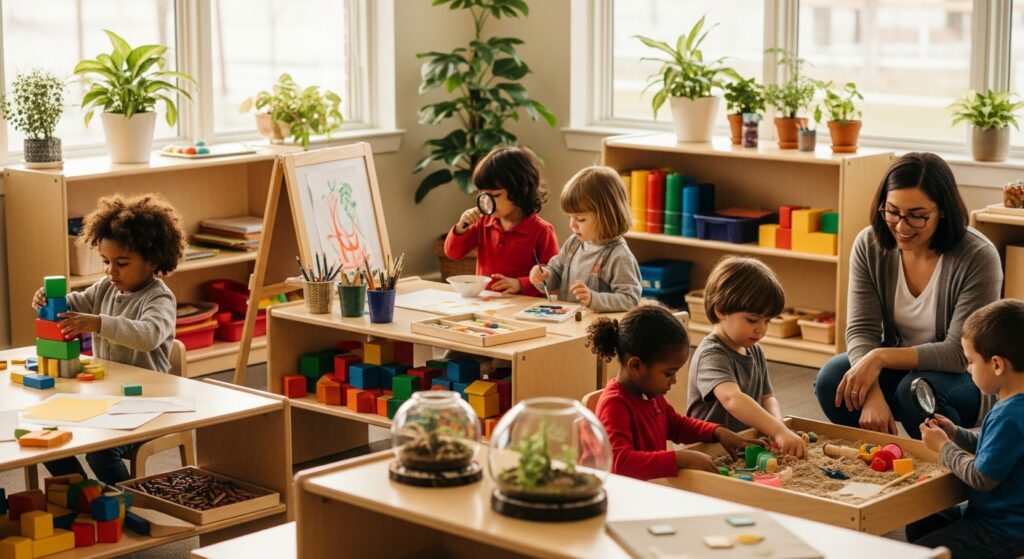
Choosing an early childhood program is a huge decision. It’s about finding a second home where your child feels supported and eager to explore. We know true school readiness goes beyond academics. It’s about nurturing the whole child—their social skills, emotional growth, and confidence. This leads to the big question: what should I consider when choosing an early childhood education program that focuses on holistic child development and school readiness? It starts with looking for a curriculum that values investigation and hands-on learning, turning play into powerful preparation for school and life.
But with so many program types available, from Montessori classrooms to Reggio Emilia-inspired centers to traditional academic preschools, knowing where to start can feel overwhelming. Each philosophy takes a different approach to how children learn, how teachers interact with students, and what a typical day looks like.
This guide breaks down the most common early childhood education program types, explains what sets each one apart, and helps you match the right approach to your child’s unique personality and your family’s values.
Understanding Holistic Child Development
When we talk about a child’s growth, it’s easy to focus on measurable milestones like learning the ABCs or counting to ten. But a child is more than their academic achievements. Holistic development is an approach that acknowledges this by focusing on nurturing every aspect of a child—social, emotional, physical, and intellectual—in an interconnected way. It’s about building the whole person, not just one part. This philosophy is the foundation of a truly enriching early education, ensuring children have all the skills they need to become happy, confident, and successful individuals. It’s about seeing them as capable and curious learners from the very beginning.
What is Holistic Development?
Think of building a house. You wouldn’t just build one room and call it finished. You need a strong foundation, sturdy walls, a protective roof, and all the interior systems working together. Holistic development is the same concept applied to your child. It’s an approach that helps a child grow in all the important ways at once: socially, emotionally, physically, and intellectually. If we only focus on academics, we’re missing the chance to build the other “rooms” that children need to feel secure and navigate the world. This approach ensures we are nurturing a well-rounded child who is not only ready for school but ready for life.
The Five Pillars of Holistic Growth
To understand holistic development, it helps to break it down into five key areas, or pillars. These pillars are all connected, and growth in one area often supports growth in another. A high-quality early learning program doesn’t treat these as separate subjects but weaves them together throughout the day. From group story time to messy art projects, every activity is an opportunity to support the whole child. At Strong Start, our curriculum is designed to address each of these pillars, creating a balanced and comprehensive learning experience for every infant, toddler, and preschooler in our care.
Cognitive and Intellectual Development
Cognitive development is all about how children think, reason, and make sense of their surroundings. It includes their ability to pay attention, remember information, solve problems, and ask questions. This isn’t about memorizing facts for a test; it’s about building the mental tools they’ll use for the rest of their lives. We encourage this growth by fostering a child’s natural curiosity. Through hands-on activities and long-term investigations, like those in The Project Approach, children learn to think critically, explore their interests deeply, and experience the joy of discovery firsthand.
Social and Emotional Well-being
Social and emotional well-being is the cornerstone of all other learning. This pillar covers how children understand and manage their feelings, build relationships with others, and develop a sense of independence. A child who feels safe, seen, and understood is a child who is ready to learn. Our exceptional educators are skilled in providing the warm, caring guidance children need to handle big emotions and learn how to get along with their peers. This supportive environment helps children build empathy, confidence, and the social skills necessary for a happy and successful school experience.
Physical Growth: Gross and Fine Motor Skills
Physical development is about more than just burning off energy. It involves both gross motor skills, which use large muscles for actions like running, jumping, and climbing, and fine motor skills, which use small muscles for tasks like drawing, writing, or buttoning a coat. Both are essential for a child’s independence and confidence. We support physical growth through active play and targeted activities. Our enrichment programs, like Fit Kids and Budding Bakers, give children fun, hands-on opportunities to strengthen their bodies and refine their coordination in a playful, supportive setting.
Language and Linguistic Skills
Language development involves how children learn to understand what they hear and express their own thoughts and ideas. It’s a critical skill that includes listening, speaking, and early literacy. Children’s language skills blossom when they are immersed in a language-rich environment. In our classrooms, we foster this through engaging conversations, reading stories, singing songs, and asking open-ended questions. Every part of your child’s day is filled with opportunities to build their vocabulary and become a confident communicator, laying the groundwork for future reading and writing success.
Spiritual Well-being
Spiritual well-being in early childhood isn’t about religion; it’s about connecting with one’s inner self and finding a sense of wonder and purpose in the world. It’s about nurturing a child’s spirit by giving them opportunities to explore their own uniqueness and connect with nature, art, and their community. This pillar helps children develop an inner compass and find meaning in their experiences. Our Reggio Emilia-inspired philosophy supports this by viewing children as full of curiosity and potential, encouraging them to express their ideas and see the beauty in the world around them.
Development vs. Learning
It’s helpful to understand the subtle difference between development and learning. Holistic development refers to the natural, gradual unfolding of a child’s abilities, much like how a baby learns to sit up, crawl, and then walk. It’s a process that happens from within. Holistic learning, on the other hand, is the active process of acquiring new knowledge or skills through teaching, practice, or experience, like learning how to read a book or ride a bike. A quality program supports natural development while also providing intentional learning opportunities that are appropriate for each child’s unique stage.
The 4 C’s: Essential Skills for Modern Learners
In addition to the five pillars, a holistic approach also focuses on building key skills that are essential for success in the 21st century. Known as the “4 C’s,” these skills are woven into the fabric of a dynamic learning environment. They are not taught as separate subjects but are practiced daily through collaborative projects and inquiry-based exploration. These skills prepare children to be adaptable, innovative, and thoughtful members of a global community.
Communication
Effective communication is about more than just talking; it’s about clearly expressing your ideas and, just as importantly, listening to and understanding the perspectives of others. In our classrooms, children are constantly practicing this skill. Whether they are sharing their findings from a nature walk, explaining their block creation to a friend, or listening to a story, they are learning how to be effective and empathetic communicators. This is a foundational skill that supports strong relationships and successful collaboration throughout life.
Collaboration
Collaboration is the ability to work together with others to achieve a shared goal. This skill is vital in a world where teamwork is valued in almost every setting, from the classroom to the workplace. Children learn to collaborate when they work on group murals, build a complex structure together, or take on different roles in a dramatic play scenario. Through long-term projects, they learn to share responsibilities, negotiate ideas, and appreciate the contributions of their peers, building a foundation for positive teamwork.
Critical Thinking
Critical thinking is the ability to analyze information, make connections, and solve problems. It’s what allows a child to move beyond simply knowing facts to truly understanding concepts. We encourage critical thinking by asking “What if?” and “Why do you think that happened?” instead of just asking for the right answer. When children are encouraged to experiment, test their theories, and learn from their mistakes, they develop the confidence and analytical skills to tackle any challenge they encounter.
Creativity
Creativity is the ability to think outside the box, imagine new possibilities, and express oneself in unique ways. It is not limited to artistic ability; it’s a way of thinking that applies to everything from problem-solving to scientific discovery. We nurture creativity by providing a wide range of open-ended materials and opportunities for self-expression. Through our Exploration Through The Arts program and daily classroom activities, children are free to experiment, innovate, and bring their own incredible ideas to life.
What Are the Main Early Childhood Education Philosophies?
Not all early childhood education programs are the same. The philosophy behind a program shapes everything from how classrooms are organized to how teachers respond when a child is struggling. Understanding these core differences is the first step toward making a confident choice.
Here is a closer look at the most widely recognized approaches.
The Montessori Approach: Child-Led Learning
Montessori education, developed by Dr. Maria Montessori in 1907, is built on the principle that children learn best when they can choose their own activities within a carefully prepared environment.
What Montessori looks like in practice:
- Children work independently or in small groups, selecting activities from organized shelves of hands-on materials
- Classrooms typically have mixed-age groups spanning three years (for example, ages 3 to 6)
- Teachers act as guides rather than directors, observing each child and introducing new materials when the child is ready
- There is a strong emphasis on practical life skills like pouring, buttoning, and food preparation
- Academic skills like reading and math are introduced through concrete, tactile materials rather than worksheets
Best suited for: Self-directed children who thrive with routine and enjoy working independently. Families who value early academic readiness through hands-on exploration.
The Reggio Emilia Approach: Learning Through Investigation
The Reggio Emilia approach originated in the towns of Reggio Emilia, Italy, after World War II. It views children as naturally curious, capable, and full of potential. Rather than following a fixed curriculum, learning emerges from the children’s own questions and interests.
What Reggio Emilia looks like in practice:
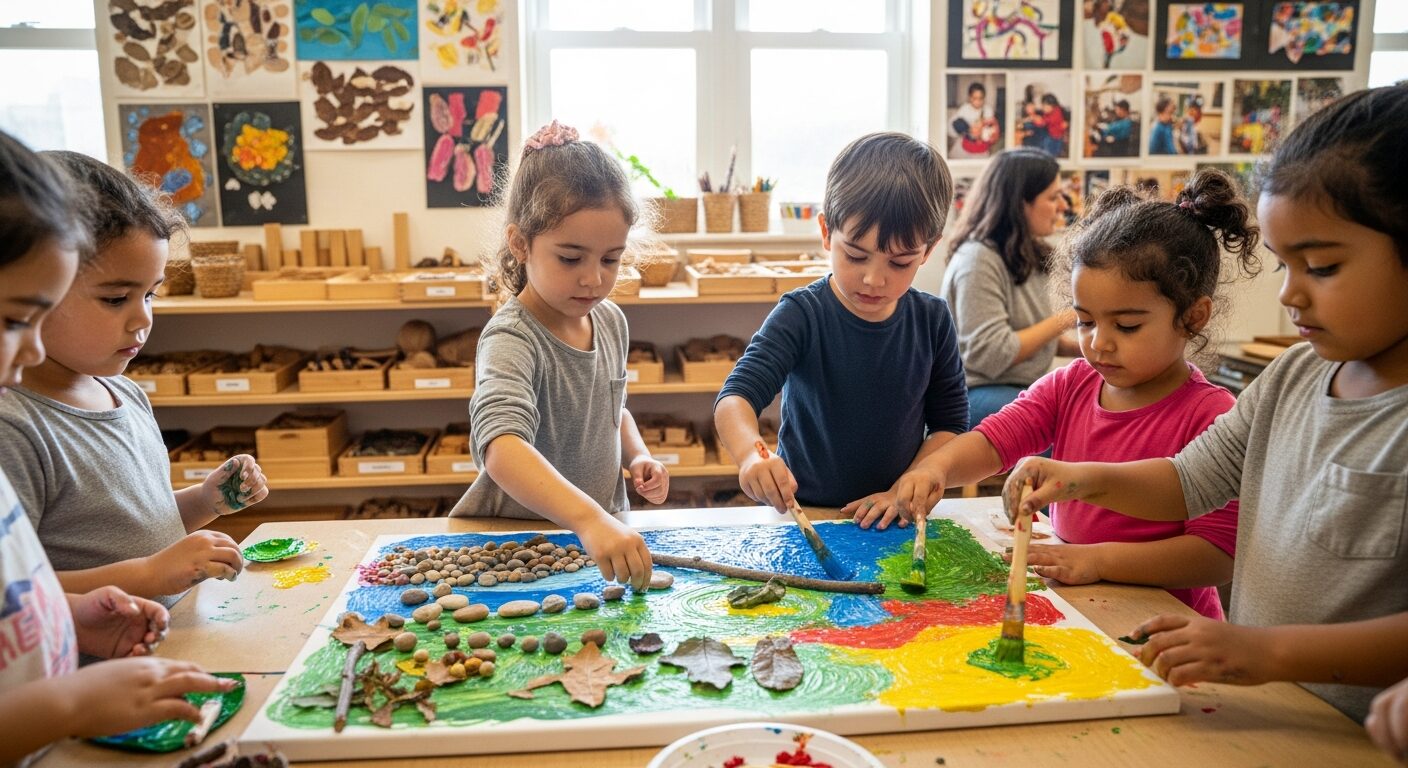
- Learning is project-based and can unfold over days or even weeks as children investigate topics that interest them
- The classroom environment is considered the “third teacher,” thoughtfully designed with natural light, open-ended materials, and spaces that invite exploration
- Documentation of children’s work, including photos, quotes, and displays of their projects, is central to the approach
- Parents are seen as essential partners in the learning process
- Teachers collaborate with children as co-learners, guiding inquiry rather than delivering instruction
Best suited for: Curious, collaborative children who love asking questions and exploring ideas in depth. Families who want to be actively involved in their child’s education.
At Strong Start Early Care and Education, our approach is grounded in the Reggio Emilia philosophy. We believe learning is most powerful when it grows from a child’s natural curiosity, supported by an environment designed to spark discovery and creativity.
Play-Based Learning: Where Fun Meets Foundational Skills
Play-based early education is rooted in decades of developmental psychology research showing that young children learn most effectively through play. This is the most common approach in nonprofit, cooperative, and community-based programs.
What play-based learning looks like in practice:
- Classrooms feature defined stations for dramatic play, blocks and building, art, sensory exploration, and reading
- Children have significant choice in how they spend their time, with teachers facilitating and extending learning during play
- Learning goals are embedded in activities rather than taught through direct instruction
- Social-emotional development, including sharing, turn-taking, and conflict resolution, receives equal emphasis alongside cognitive skills
- The distinction between “free play” and “guided play” matters; high-quality programs balance both intentionally
Best suited for: Most children, especially those who learn through movement, social interaction, and hands-on activities. Families who prioritize social-emotional development alongside academic readiness.
The Waldorf Approach: Nurturing the Whole Child
Waldorf education, founded by Rudolf Steiner in 1919, emphasizes nurturing the whole child through a rhythm of creative, practical, and intellectual activities. Early childhood Waldorf programs focus heavily on imagination, storytelling, and nature.
What Waldorf looks like in practice:
- Days follow a predictable rhythm of active and quiet activities, including circle time with songs and movement, creative play, outdoor time, and rest
- Classrooms use natural materials like wool, wood, silk, and beeswax rather than plastic toys
- There is no formal academic instruction in the early years; reading and math are introduced later, typically after age 7
- Screen time is strongly discouraged or eliminated entirely
- Artistic expression through watercolor painting, drawing, and handwork is part of every day
Best suited for: Imaginative children who thrive with routine, nature, and creative expression. Families who prefer delayed formal academics and want a screen-free environment.
Academic Programs: A Focus on School Readiness
Academic preschool programs focus on building specific school-readiness skills through structured lessons and teacher-led activities. These programs often use a published curriculum and assess progress through measurable benchmarks.
What academic programs look like in practice:
- The day follows a structured schedule with defined periods for language arts, math, science, and social studies
- Teachers lead lessons and children complete activities as a group
- There may be homework, assessments, or progress reports
- Letter recognition, phonics, counting, and writing practice are core daily activities
- Circle time, read-alouds, and structured art activities round out the day
Best suited for: Children who respond well to structure, clear expectations, and teacher-led activities. Families who prioritize measurable academic preparation for kindergarten.
The HighScope Method: Plan, Do, Review
The HighScope method is built around a simple, powerful cycle: plan, do, review. This approach empowers children to take charge of their own learning by making intentional choices. Each day, children plan what they want to do—perhaps build a tower in the block area or create a painting at the easel. They then carry out their plan, and afterward, they reflect on their experience with teachers and peers. This process helps children develop critical thinking, problem-solving, and executive function skills. In a HighScope classroom, teachers work with kids as partners, asking questions that encourage them to think more deeply about their work and discoveries. The focus is on active, participatory learning where children are the drivers of their own education.
The Bank Street Approach: Focus on the Whole Child
The Bank Street approach, also known as the Developmental-Interaction Approach, is centered on the “whole child.” This philosophy recognizes that for children to learn effectively, their emotional, social, physical, and cognitive needs must all be met. Learning is seen as an interactive process that happens through real-world experiences and play. Instead of a rigid, one-size-fits-all curriculum, teachers meet children where they are developmentally and create learning opportunities based on their interests. A trip to a local market might become a lesson on counting, colors, and community. This approach helps children make sense of the world around them, building a strong foundation of social-emotional intelligence and a genuine love for learning that extends far beyond the classroom walls.
Finding the Right Program for Your Unique Child
Every child has their own temperament, learning style, and pace of development. The best program for your neighbor’s child may not be the best fit for yours. Instead of choosing based on reputation alone, consider how your child actually learns and interacts with the world.
If your child loves independence and focus: A Montessori environment may be a natural fit, with its emphasis on self-directed work and carefully sequenced materials.
If your child is endlessly curious and loves projects: A Reggio Emilia-inspired program channels that curiosity into deep, extended investigations that build critical thinking and collaboration. At Strong Start, our classrooms use the Project Approach to turn children’s questions into meaningful learning experiences that can unfold over weeks.
If your child is social and learns through movement: A play-based program gives children the freedom to learn through interaction, exploration, and physical activity.
If your child thrives on routine and imagination: Waldorf education offers a predictable rhythm paired with rich creative experiences.
If your child responds to clear structure: An academic program provides the guided, step-by-step instruction some children need to feel confident and successful.
There is no single right answer. Many high-quality programs blend elements from multiple philosophies. What matters most is that the program respects your child as an individual and supports their growth across all domains: cognitive, social, emotional, and physical.
Check the Program’s Reputation and References
A program’s website offers the official story, but its reputation reveals what happens day-to-day. Start by reading online reviews and testimonials, like the feedback we share from our families, but dig deeper. Ask the director if you can speak with a few current parents. A program that is confident in its community will be happy to connect you. Beyond personal experiences, look for official marks of quality. While state licensing is a must-have, accreditation is a sign of true excellence. Choosing a NAEYC-accredited program, for instance, means it has voluntarily met rigorous standards. Finally, ask about communication. You want a program that sees you as a true partner in your child’s education, with consistent updates and an open-door policy.
What Should I Ask During a Preschool Tour?
Regardless of the philosophy a program follows, certain quality indicators apply across the board. When you visit or research a program, ask these questions:
About the curriculum:
- What is your educational philosophy, and how does it guide daily activities?
- How do you balance structured learning with child-directed exploration?
- How do you support children who are ahead of or behind their peers developmentally?
About the teachers:
- What qualifications do your lead teachers hold?
- What is the teacher-to-child ratio in each classroom?
- How long have your current teachers been with the program?
About the environment:
- Can I observe a classroom during a typical day?
- How is the classroom organized? What materials are available to children?
- What is your approach to outdoor play and physical activity?
About communication:
- How do you keep parents informed about their child’s progress and daily experiences?
- Are parents welcome to visit or participate in classroom activities?
- How do you handle concerns or feedback from families?
Strong teacher-to-child ratios are one of the most reliable indicators of program quality. The National Association for the Education of Young Children (NAEYC) recommends ratios no higher than 1:10 for preschool-age children, with smaller ratios for infants and toddlers. Programs that carry NAEYC accreditation meet rigorous standards for teacher qualifications, curriculum, and family engagement.
Questions About Health and Safety
Nothing is more important than your child’s well-being. A great program should not only meet but exceed basic health and safety requirements. When you tour a center, look for evidence of cleanliness and ask about their specific protocols. Inquire about their emergency plans for situations like fires or medical incidents. It is also critical to understand how they manage food allergies and dietary restrictions to ensure every child is safe during meals and snack times. A program’s commitment to these details shows its dedication to creating a secure and nurturing space where children can thrive without worry.
Beyond what you can see, ask about the program’s licensing and accreditation status. Is it licensed by the state, and are those records in good standing? At Strong Start, we believe that a safe environment is the foundation for all learning, which is why we have comprehensive health and safety policies that cover everything from secure check-in procedures to rigorous cleaning schedules. Don’t hesitate to ask for specifics; a quality program will be proud to share how they protect the children in their care and will welcome your questions as a sign of a thoughtful, engaged parent.
Questions About the Curriculum and Learning
A program’s curriculum is its roadmap for learning. It should be thoughtfully designed to prepare children for the next steps in their education while honoring their developmental stage. A quality curriculum balances playtime with structured activities, recognizing that children learn just as much from building a block tower with a friend as they do from a teacher-led circle time. Ask how the program supports all areas of development: social skills for making friends, emotional intelligence for understanding feelings, and cognitive abilities for thinking and problem-solving. The goal is to foster a love of learning, not just to teach letters and numbers.
Developmental Milestones and Individual Progress
Every child develops at their own unique pace, and a one-size-fits-all curriculum can leave some children feeling bored and others feeling left behind. One of the most important questions you can ask is, “How do you support children who are ahead of or behind their peers developmentally?” A great program will have a clear answer, describing how teachers observe children, document their progress, and tailor activities to meet individual needs. This might involve providing more challenging materials for an advanced learner or offering extra support and encouragement to a child who is still mastering a skill. This individualized approach ensures every child feels successful and confident.
Alignment with State Standards
While early childhood education should be about more than just checking boxes, it is important that a program’s curriculum aligns with established educational goals. Many states have early learning and development standards that outline what children should know and be able to do by a certain age. Ask if the program’s curriculum is aligned with these state guidelines. High-quality programs, especially those with national accreditation, often have standards that go above and beyond state minimums. For example, programs with NAEYC accreditation have demonstrated their commitment to a rigorous, research-backed curriculum that supports every aspect of a child’s development, ensuring they are well-prepared for kindergarten and beyond.
Teacher Qualifications and Performance Data
A beautiful classroom and a well-designed curriculum are only as effective as the teachers who bring them to life. The daily interactions your child has with their teachers are the most critical component of their early learning experience. Ask about the qualifications, training, and experience of the staff. Do lead teachers have degrees in early childhood education or a related field? What kind of ongoing professional development does the program provide? Low teacher turnover is often a sign of a positive and supportive work environment, which translates to more consistent and stable care for your child. We believe so strongly in this that we are committed to hiring and retaining exceptional educators who are passionate about their work.
Questions About Support for Diverse Needs
Every child is unique, and some may require additional support to fully participate and thrive in a classroom setting. If your child has a diagnosed special need, receives services like speech or occupational therapy, or you simply have concerns about a developmental delay, it is essential to be upfront with any potential program. Ask directly if they have experience with children with similar needs and what specific supports they can provide. Can they accommodate outside therapists visiting the classroom? Do they have staff trained to offer specialized assistance? Finding a program that sees itself as a partner and is willing to collaborate with you and other specialists will make all the difference in your child’s success and happiness.
Questions About Practical and Financial Details
Choosing an early childhood program is also a practical decision that has to work for your family’s daily life and budget. While philosophy and curriculum are vital, the logistics of location, hours, and cost are equally important factors in making a sustainable choice. Childcare can be a significant portion of a family’s income, so it is crucial to understand all the associated costs and how the program’s schedule aligns with your work and family commitments. Thinking through these practical details from the start will help you narrow down your options to the programs that are a truly viable fit for your family’s circumstances.
Program Flexibility and Schedule
The best program in the world won’t work if you can’t get there. Consider the program’s location and what your daily commute will look like. Does the center’s schedule align with your work hours? Ask about their drop-off and pick-up windows, policies for late pick-ups, and what happens on holidays or during school breaks. Many programs, like our Trumbull school, offer full-day, year-round care designed to support working families. Understanding the daily rhythm and annual calendar will help you determine if a program’s schedule is compatible with your family’s needs, preventing logistical stress down the road.
Cost, Tuition, and Financial Aid
The cost of high-quality childcare is a significant investment, and it is important to have a clear picture of the total expense. When you inquire about tuition, be sure to ask for a complete breakdown of all potential costs, including registration fees, material fees, and any charges for special activities. Ask about the payment schedule and what options are available. Many families are not aware that they may be eligible for assistance. Inquire if the program accepts state subsidies or offers its own financial aid or scholarships. Additionally, some employers offer assistance, so it is worth checking if your company provides a tuition benefit that can help make a high-quality program more affordable.
Does Preschool Accreditation Really Matter?
State licensing sets the minimum standards a childcare program must meet to operate legally. Accreditation, on the other hand, represents a higher level of quality that programs pursue voluntarily.
NAEYC accreditation is the gold standard in early childhood education. Fewer than 10 percent of childcare programs nationwide hold this designation. Accredited programs meet standards in ten areas, including curriculum, teaching practices, health and safety, teacher qualifications, and family partnerships.
When evaluating programs, ask whether the program is licensed by the state and whether it holds any national accreditation. A program’s willingness to share its inspection reports and accreditation status tells you a lot about its commitment to transparency and quality.
Trusting Your Gut: The Importance of the School Visit
Reading about philosophies and checking credentials are important first steps. But nothing replaces an in-person visit. When you walk into a classroom, pay attention to the atmosphere. Are children engaged and happy? Are teachers warm and attentive? Does the space feel organized, clean, and inviting?
Watch how teachers respond when a child is upset, when two children disagree, or when a child needs help. These small moments reveal the true character of a program far more than any brochure or website.
If possible, visit during a regular class time rather than during a formal open house. You want to see the program as it actually operates on a typical day.
And trust your instincts. You know your child better than anyone. If something feels off, it probably is. If a program feels warm, responsive, and genuinely child-centered, that feeling matters too.
The Long-Term Benefits of Quality Early Education
Choosing an early education program is one of the first big decisions we make as parents, and its impact lasts long after the last finger painting comes home. A high-quality program does more than just prepare a child for kindergarten; it nurtures their holistic development, which means supporting their growth in every essential way—socially, emotionally, physically, and intellectually. This is where children learn how to share ideas, work as a team, and think creatively to solve problems. These foundational skills, like empathy and independence, are the tools they will carry with them through every stage of life, helping them become confident, capable, and well-rounded individuals.
This focus on the whole child is what sets the stage for future academic and personal success. Research consistently shows that children who attend high-quality early education programs tend to perform better in school, are more likely to graduate, and can even have higher earning potential as adults. When children are encouraged to ask questions and explore their interests, as they do with the Project Approach, they aren’t just learning facts. They are learning *how* to learn. This deep, engaged approach to education builds a love of discovery that fuels their social, emotional, and cognitive growth for years to come.
Making Your Final Choice with Confidence
Choosing the right early childhood education program is one of the most important decisions you will make for your child’s early years. By understanding the different philosophies, knowing what questions to ask, and observing programs firsthand, you can make a choice that aligns with your child’s needs and your family’s values.
At Strong Start Early Care and Education, we welcome families to schedule a tour and experience our Reggio Emilia-inspired classrooms firsthand. Our enrichment programs in STEM, movement, cooking, and the arts are included in tuition, and our NAEYC-accredited programs serve children from six weeks through pre-K across our Trumbull, Shelton, and Wilton locations.
The best program for your child is the one where they feel seen, supported, and excited to learn every day.
Frequently Asked Questions
With so many different philosophies, how do I know which one is truly the best? The truth is, there is no single “best” philosophy that works for every child. The best program is the one that is the best fit for your child and your family’s values. Instead of getting caught up on a specific label, focus on how a program feels in practice. A high-quality program, regardless of its official philosophy, will have warm, engaged teachers and a deep respect for children as capable learners. The right choice is the place where your child will feel happy, supported, and excited to explore.
I’m touring several schools. What is the most important thing I should pay attention to? Look past the new toys and colorful walls and focus on the interactions. Watch how the teachers talk to the children. Do they kneel down to their level, ask thoughtful questions, and genuinely listen to the answers? Observe how they handle small conflicts or comfort a child who is upset. These human moments will tell you more about the quality of a program than any brochure ever could. A positive, respectful relationship between teachers and children is the foundation of all great learning.
My child is very social and learns by doing. Does this mean a more academic program is a bad idea? Not necessarily, but it is an important factor to consider. The key is to understand how a program defines “academic.” A great program can build school-readiness skills without requiring children to sit still for long periods. Look for a center that integrates learning into hands-on activities, group projects, and even playtime. The goal is to find a place that honors your child’s natural energy and learning style while still preparing them for kindergarten. A tour is the perfect time to ask how they support different types of learners within their daily structure.
Many programs say they are “play-based.” How is a Reggio Emilia-inspired approach different? This is a great distinction to make. While both value hands-on learning, the Reggio Emilia approach is more specific. Think of it as play with a purpose that is driven by the children’s own curiosity. Instead of just providing blocks, a Reggio-inspired teacher might notice children are interested in building bridges, then guide them on a long-term project to investigate different types of structures. It is a collaborative partnership where teachers and children learn together, turning a simple interest into a deep, meaningful investigation.
How much does something like NAEYC accreditation really matter for my child’s experience? It matters quite a bit, as it is a reliable sign of a program’s commitment to excellence. While state licensing ensures basic safety, NAEYC accreditation is a voluntary process that holds schools to much higher standards for everything from teacher qualifications and curriculum quality to family partnerships. Choosing an accredited program gives you peace of mind, knowing the center has been thoroughly vetted by experts and is dedicated to providing the best possible environment for your child’s growth and development.
Key Takeaways
- Focus on the whole child, not just academics: A quality program nurtures your child’s social, emotional, and physical skills alongside their intellectual growth, building a strong foundation for school and life.
- Match the philosophy to your child’s personality: Understanding the differences between approaches like Reggio Emilia, Montessori, and play-based learning helps you choose an environment that fits how your child naturally explores and interacts with the world.
- Go beyond the website and visit in person: Ask specific questions about teacher qualifications, safety, and accreditation, but also trust your instincts during a tour; the right program will feel warm, engaging, and supportive.
Related Articles
- How to Choose the Right Early Childhood Education Program – Strong Start
- A Parent’s Guide to Private Preschool Programs – Strong Start
Written By
Marc Hoffman
Founder, Strong Start Early Care & Education
Marc founded Strong Start in 2014, inspired by his studies at Williams College, Yeshiva University, and research at Yale University. His child-centered, inquiry-based approach to early education has helped hundreds of families in the Trumbull and Bridgeport communities. As a parent himself, Marc understands the importance of finding a nurturing environment where every child can learn, grow, and flourish.