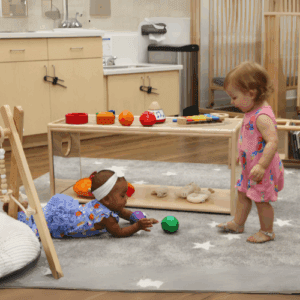
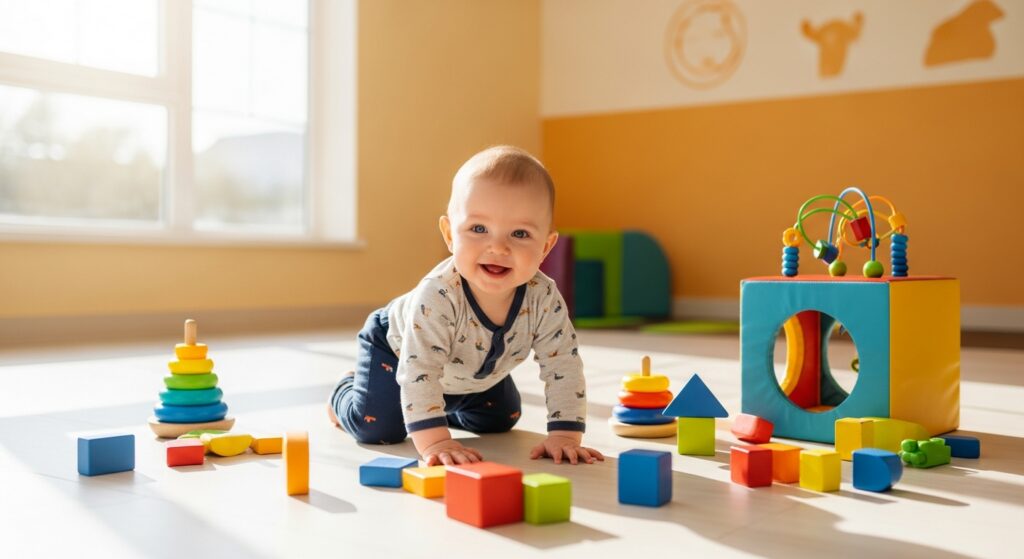
Few moments compare to watching your baby go from stationary to mobile. That first army crawl across the living room or a wobbly hands-and-knees sprint changes everything! It also tends to generate a lot of questions. If you’re asking, at what age do babies crawl?, you’re not alone. Many parents also wonder at what age babies should start crawling and what the different styles even mean. While every baby follows their own unique timeline, we’ll walk through the typical milestones and signs to look for as your little one gets ready to move.
If you’re wondering, when do babies start crawling?, you’re not alone. It’s one of the most common questions parents ask pediatricians, childcare providers, and each other. The answer isn’t as simple as a single age, but understanding the typical timeline, the signs of readiness, and the different ways babies move can help you feel confident about your child’s development.
At Strong Start Early Care & Education, our educators work with infants every day and see firsthand how each child approaches this milestone in their own way. Here’s what you need to know.
At What Age Do Babies Start Crawling?
Most babies begin crawling between 6 and 10 months of age, with the average falling around 7 to 9 months. Some babies start scooting as early as 6 months, while others don’t become fully mobile until closer to their first birthday, and both timelines are completely normal.
Crawling isn’t actually listed as a required milestone by the American Academy of Pediatrics because the way babies get from point A to point B varies so widely. What matters more than the specific method is that your baby is showing interest in moving and exploring their surroundings.
A few things that influence when babies crawl:
- Muscle strength and tone — Babies need strong core, arm, and leg muscles before they can support themselves on all fours.
- Motivation — Some babies are content to sit and observe, while others are determined to get to everything they see.
- Opportunity — Babies who spend more time on the floor during supervised play tend to develop crawling skills earlier than those who spend most of their time in bouncers, swings, or carriers.
- Body type — Larger babies sometimes take a bit longer to coordinate the movements needed for crawling, and that’s perfectly fine.
The Newborn Crawling Reflex
You might be surprised to learn that babies are born with a “crawling reflex.” As Huckleberry notes, “Newborns have a natural ‘crawling reflex’ that helps them move towards their mother’s breast right after birth.” If you place a newborn on their tummy, you might see them make little crawling motions with their legs. This instinct is a powerful survival tool that helps them find nourishment in their first moments of life. This reflex typically fades after a couple of months, but it’s a beautiful reminder of the innate abilities babies possess from day one. It’s a precursor to the intentional, coordinated movements they will develop later in our infant classrooms.
How Crawling Can Affect Sleep
Just when you thought you had a solid sleep routine, your baby learns to crawl—and suddenly, bedtime feels like a free-for-all. If this sounds familiar, you’re not alone. Learning a new skill is incredibly exciting for a baby, and they often want to practice it at all hours, even in their crib. According to Huckleberry, “As babies become excited about their newfound mobility, they may practice crawling in their crib instead of sleeping.” This can lead to a temporary sleep disruption, often called a sleep regression. While it can be frustrating, try to remember that it’s a positive sign of cognitive and physical development. This phase usually passes once the novelty wears off.
Is Crawling Still a Milestone?
For generations, crawling was seen as a non-negotiable developmental milestone. If you’ve been worried because your little one seems less interested in crawling, you can relax. The official guidance has changed. So, is crawling still a milestone? The short answer is no, not in the way it used to be. According to Lurie Children’s, “Crawling is no longer considered a primary milestone by the CDC, as less than 75% of babies crawl.” The focus has shifted from the specific act of crawling to a baby’s overall interest in moving and exploring their environment. This is a more inclusive approach that acknowledges the many different ways babies learn to get around.
Some babies become expert rollers, while others prefer to scoot on their bottoms or pull themselves forward with their arms in a “commando crawl.” All of these are valid and effective forms of movement. What matters most is that your baby is motivated to explore their world and is building the strength and coordination to do so. At Strong Start, our child-led philosophy means we celebrate each child’s unique path to mobility. We create safe, stimulating environments where infants are free to discover movement in a way that feels natural to them, whether that involves a classic crawl or a creative scoot.
The CDC’s Updated Guidelines
The shift away from crawling as a key milestone is reflected in the latest guidance from the Centers for Disease Control and Prevention (CDC). As Huckleberry explains, “The CDC has updated its guidelines and removed crawling as a specific milestone due to the wide range of developmental timelines among infants.” This change was made to reduce parental anxiety and to better reflect what experts see in practice: that there is a wide spectrum of normal development. Instead of looking for one specific movement, the updated milestones encourage parents and professionals to observe whether a child is learning to move and interact with their surroundings in some way, preparing them for the next stage of development, like pulling up to stand.
Is Your Baby Ready to Crawl? 5 Signs to Watch For
Crawling doesn’t happen overnight. Before your baby takes off across the room, you’ll likely notice a series of smaller developmental steps building up to it.
Pushing Up on Their Arms
When your baby can push up onto their hands during tummy time, lifting their chest off the floor, it’s a strong sign their upper body strength is developing. This is one of the earliest precursors to crawling.
Rocking on Hands and Knees
This one gets parents excited. Your baby gets into the crawling position and rocks forward and backward without actually going anywhere. It looks like they’re about to launch, and they are. They’re building the coordination to move their arms and legs in an alternating pattern.
Pivoting and Spinning
Before crawling forward, many babies learn to pivot on their belly, spinning in circles to reach objects around them. This shows they’re developing the core strength and spatial awareness needed for directional movement.
The Backward Scoot
It seems counterintuitive, but many babies scoot backward before they figure out how to move forward. Their arm muscles are often stronger than their leg muscles at this stage, so pushing results in backward motion. Forward crawling usually follows within a few weeks.
Sitting Up Without Support
A baby who can sit without support has developed the core stability that’s essential for crawling. The transition from sitting to a crawling position is a key motor planning skill.
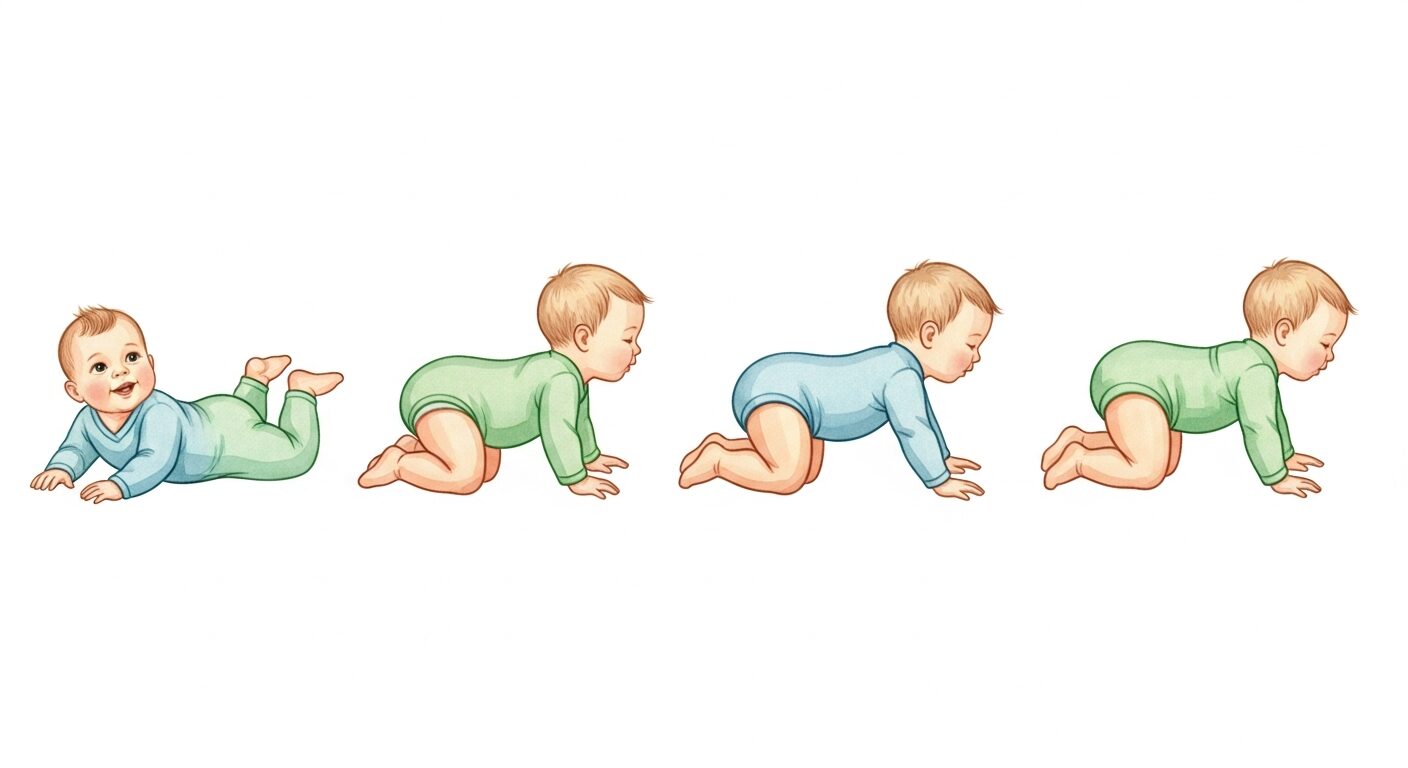
The Many Styles of Baby Crawling
Not every baby crawls the way you might picture. In our infant classrooms, we see all kinds of crawling styles, and every one of them counts.
The Classic Crawl
The traditional crawl: hands flat on the floor, knees on the ground, moving opposite arm and leg at the same time. This is the most common style, and it’s excellent for bilateral coordination.
The Commando Crawl
Your baby drags themselves forward using their forearms while their belly stays on the floor. This is often the first type of crawling babies attempt and usually transitions to a hands-and-knees crawl as they get stronger.
The Bear Crawl
This is an advanced version of the classic crawl. Instead of their knees, your baby keeps their legs straight and walks on their hands and feet, like a little bear. This style requires significant strength and coordination and is often a sign that walking is just around the corner.
The Crab Crawl
Just like the name suggests, your baby sits on their bottom and uses their arms to push themselves backward or sideways. It’s an effective, if unconventional, way to get around. Babies who prefer this method are still building arm and core strength.
The Bottom Scoot
Similar to the crab crawl, the bottom scoot involves your baby sitting upright and pulling themselves forward with their legs. Some babies become very efficient scooters and may even skip the hands-and-knees crawling stage altogether, which is perfectly normal.
What Crawling Strengthens: More Than Just Movement
Crawling is so much more than just your baby’s first taste of independence; it’s a comprehensive developmental workout that sets the stage for future learning and movement. Think of it as a full-body exercise that strengthens nearly every major muscle group, from their hands and arms to their shoulders, core, and legs. This foundational strength is exactly what they’ll need for the next big milestones, like pulling up to stand and eventually taking those first steps. At Strong Start, our infant classrooms are designed to give little ones plenty of safe, open floor space to build these crucial muscles at their own pace.
Beyond pure strength, crawling is a powerhouse for brain development. As your baby moves an opposite arm and leg at the same time—a motion called cross-lateral movement—they are building a superhighway between the left and right sides of their brain. This coordination is essential for balance and also refines hand-eye coordination. At the same time, bearing weight on their palms strengthens the small muscles in their hands, preparing them for future fine motor skills like holding a crayon or using a spoon. It’s a powerful step that builds their body and brain simultaneously.
The Bear Crawl
Hands and feet on the floor with straight legs, bottom up in the air. It looks a bit like a yoga pose, and some babies prefer it. Bear crawling builds incredible leg strength.
The Bottom Scoot
Some babies skip the whole hands-and-knees routine and scoot around on their bottoms, using one hand to push themselves forward. This is more common than you might think, and these babies often transition directly to walking.
The Bear Crawl
This is an advanced version of the classic crawl. Instead of their knees, your baby keeps their legs straight and walks on their hands and feet, like a little bear. This style requires significant strength and coordination and is often a sign that walking is just around the corner.
The Crab Crawl
Just like the name suggests, your baby sits on their bottom and uses their arms to push themselves backward or sideways. It’s an effective, if unconventional, way to get around. Babies who prefer this method are still building arm and core strength.
The Bottom Scoot
Similar to the crab crawl, the bottom scoot involves your baby sitting upright and pulling themselves forward with their legs. Some babies become very efficient scooters and may even skip the hands-and-knees crawling stage altogether, which is perfectly normal.
What Crawling Strengthens: More Than Just Movement
Crawling is so much more than just your baby’s first taste of independence; it’s a comprehensive developmental workout that sets the stage for future learning and movement. Think of it as a full-body exercise that strengthens nearly every major muscle group, from their hands and arms to their shoulders, core, and legs. This foundational strength is exactly what they’ll need for the next big milestones, like pulling up to stand and eventually taking those first steps. At Strong Start, our infant classrooms are designed to give little ones plenty of safe, open floor space to build these crucial muscles at their own pace.
Beyond pure strength, crawling is a powerhouse for brain development. As your baby moves an opposite arm and leg at the same time—a motion called cross-lateral movement—they are building a superhighway between the left and right sides of their brain. This coordination is essential for balance and also refines hand-eye coordination. At the same time, bearing weight on their palms strengthens the small muscles in their hands, preparing them for future fine motor skills like holding a crayon or using a spoon. It’s a powerful step that builds their body and brain simultaneously.
The Crab Crawl
Your baby moves sideways or backward, pushing off with their hands in an asymmetrical pattern. While it looks unusual, it’s still a valid form of locomotion that develops motor skills.
Rolling to Get Around
A few determined babies figure out that rolling is the fastest way to get where they want to go. While it’s not technically crawling, it shows motivation, body awareness, and coordination.
Why Tummy Time Is Key for Crawling
If there’s one thing early childhood development experts agree on, it’s that tummy time matters. The connection between supervised belly-down play and crawling readiness is well established.
Tummy time strengthens the muscles your baby needs for crawling: the neck, shoulders, arms, back, and core. It also helps develop head control, which is essential for looking around while moving.
When to start: Tummy time can begin in the first week after birth, starting with just a few minutes at a time on a parent’s chest or a firm, flat surface.
How much: The American Academy of Pediatrics recommends working up to 15 to 30 minutes of total tummy time per day by the time your baby is 2 months old, spread throughout the day in short sessions.
Tips for reluctant babies:
- Get down on the floor with them at eye level
- Place a favorite toy or mirror just out of reach
- Try tummy time on your chest while you recline
- Keep sessions short and positive; stop before your baby becomes frustrated
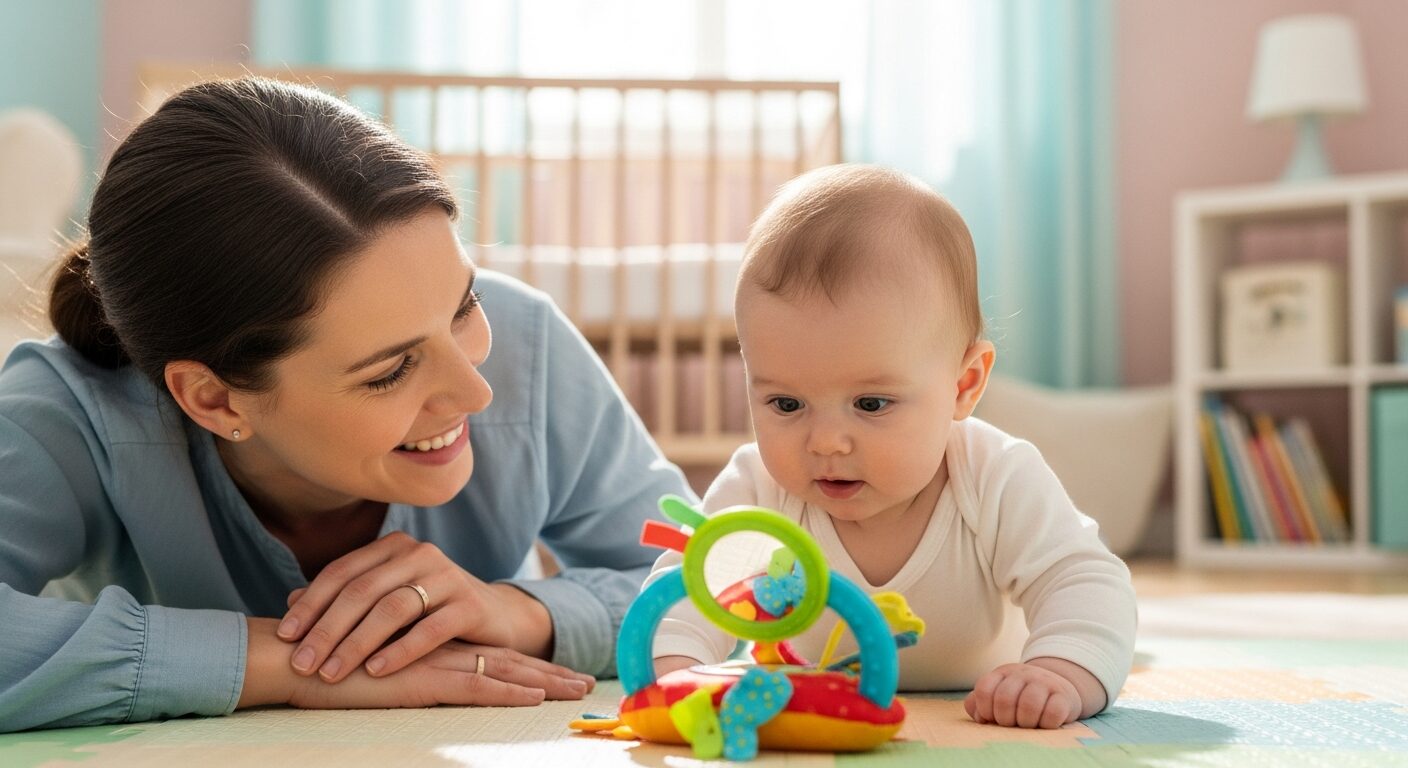
At Strong Start, tummy time is a structured part of our infant program. Our teachers create safe, engaging floor-play environments that encourage babies to build the strength and curiosity they need to become mobile.
How to Encourage Crawling
While every baby develops on their own unique schedule, you can create a supportive environment that encourages them to explore movement. It’s not about rushing the milestone, but about providing plenty of opportunities for your baby to build strength, coordination, and curiosity. Think of it as setting the stage for them to discover what their body can do. A few simple strategies can make a big difference in helping your little one get ready to crawl.
Create a “Yes” Space
A “yes” space is a designated area of your home that is completely baby-proofed, allowing your child to explore freely without you having to say “no.” When your baby doesn’t have to worry about bumping into sharp corners or getting into things they shouldn’t, they can focus all their energy on movement. Clear a space on the floor, cover outlets, and secure furniture. This freedom to move is fundamental for building the confidence to crawl. Creating a safe environment for exploration is a cornerstone of our approach at Strong Start, ensuring every child can learn and grow with confidence. You can learn more about our commitment to health and safety on our website.
Use Motivating Toys and Mirrors
A little motivation can go a long way. Place a few favorite toys just beyond your baby’s reach to encourage them to stretch, pivot, and eventually move forward. Toys that roll, like soft balls, are especially effective. Another fantastic tool is a baby-safe mirror placed on the floor. Babies are naturally social and fascinated by faces—including their own. Seeing their reflection can motivate them to push up and move closer for a better look. This method aligns with the Reggio Emilia philosophy, which views the environment as a “third teacher” that inspires curiosity and discovery.
Get Down on Their Level
Your baby’s favorite plaything is you. Getting on the floor with them is one of the most powerful ways to encourage crawling. Lie down opposite them during tummy time, make eye contact, and talk to them. You can even demonstrate crawling yourself to show them how it’s done. Making it a game turns skill-building into a fun, bonding experience. This kind of active engagement is central to our philosophy of partnering with parents to support a child’s development. When your baby sees you as a playful partner in their exploration, they’ll feel more secure and motivated to try new things.
Limit Time in “Containers”
“Containers” are devices like bouncers, activity centers, and stationary jumpers that hold a baby in one place. While they can be helpful for keeping your baby safe for a few minutes, overuse can delay crawling by restricting free movement. Babies need ample floor time to learn how their bodies move in space, build core strength, and practice the motions that lead to crawling. Try to prioritize supervised floor play over container time whenever possible. This gives your baby the best opportunity to work on the physical skills they need to become mobile and explore their world on their own terms.
When to Talk to a Doctor About Crawling
Every baby develops at their own pace, and there’s a wide range of normal when it comes to crawling. Some babies crawl early, some crawl late, and some skip crawling entirely and go straight to pulling up and walking.
That said, there are a few situations where it’s worth checking in with your pediatrician:
- No interest in movement by 12 months — If your baby isn’t crawling, scooting, rolling, or showing any desire to move by their first birthday, a developmental screening can provide clarity.
- Only using one side of the body — If your baby consistently favors one arm or leg while moving, it could indicate a muscle or neurological issue worth evaluating.
- Loss of skills — If your baby was making progress toward crawling and then stopped or regressed, mention this to your pediatrician.
- Significant stiffness or floppiness — Unusually tight or very loose muscle tone can affect motor development and may warrant a professional evaluation.
Most of the time, late crawlers are simply taking a different developmental path. Many babies who skip crawling entirely are perfectly on track. The key is to look at the overall picture of your child’s development, not just one milestone in isolation.
Developmental Red Flags to Watch For
While you can rest assured that every baby moves at their own pace, it’s also smart to know which signs might call for a chat with your pediatrician. For instance, if your baby was making good progress toward moving and then seems to have stopped or regressed, it’s worth bringing up. Also, take note of how your baby moves. Consistently favoring one side of the body or using one arm or leg much more than the other could signal an underlying issue. Pay attention to their muscle tone as well—if they feel unusually stiff or especially floppy, a professional evaluation can provide peace of mind and rule out any motor development concerns.
Not Bearing Weight on Legs
Around the same time they’re figuring out crawling, many babies also start testing out their legs. When you hold your baby upright, they should begin to push down with their feet and bear some of their own weight. If your little one consistently resists putting weight on their legs, or if their legs seem very stiff or floppy when you try, it’s a good idea to bring it up with your doctor. This skill is a crucial building block for pulling up and eventually walking, so a reluctance to bear weight can sometimes be related to muscle tone or motor coordination issues that might also affect crawling.
Accessing Early Intervention Services
If you have any concerns about your child’s development, trust your instincts. The first step is always to talk with your child’s pediatrician. They can assess your baby’s overall progress and determine if a referral is needed. You also have the right to seek support directly. In the U.S., you can request a free evaluation from your state’s early intervention program, which provides services for children from birth to age three with developmental delays. At Strong Start, we believe in partnering with parents, and our experienced educators are always here to discuss your child’s progress and help you find the right resources and support for your family.
7 Simple Ways to Encourage Your Baby to Crawl
1. Offer Plenty of Floor Time
The more time your baby spends on the floor during supervised play, the more opportunities they have to practice the movements that lead to crawling. Limit time in containers like bouncers, swings, and walkers.
2. Use Toys for Motivation
Put an enticing toy slightly beyond your baby’s grasp to motivate them to move toward it. The key word is slightly. You want to encourage, not frustrate.
3. Baby-Proof Your Crawling Zone
Clear an area of the floor free from sharp edges, choking hazards, and anything that could topple over. Babies are more likely to experiment with movement when they feel safe.
4. Secure Stairs and Furniture
Once your baby is on the move, your home environment changes instantly. As we mentioned, babies who spend more time on the floor during supervised play tend to develop crawling skills earlier. Your job is to make that floor a safe space for exploration. Install baby gates at the top and bottom of all stairs—pressure-mounted gates are fine for blocking rooms, but you’ll want hardware-mounted gates for stairways. Anchor heavy furniture like bookcases, dressers, and TV stands to the wall to prevent them from tipping over if your baby tries to pull up on them. This is a crucial step in creating a safe environment for your new explorer.
5. Supervise Pets
Your family dog or cat is about to become the most interesting “toy” in the house. A crawling baby’s movements can be jerky and unpredictable, which can startle even the most patient pet. It’s important to remember that just as we look at the overall picture of your child’s development, we also need to consider how their new skills affect everyone in the home. Never leave your baby and pet unsupervised, no matter how much you trust your animal. Teach your baby gentle touches from the start, and make sure your pet always has an escape route to a baby-free zone. Constant supervision is essential for the safety of both your child and your beloved pet.
4. Get Down on Their Level
Babies learn by watching. When you get down on the floor and model crawling or simply play at their level, you’re showing them that the floor is an interesting place to be.
5. Try Gentle “Push-Ups” and Rocking
You can also encourage specific movements that build crawling muscles. When your baby starts doing little “push-ups” during tummy time—lifting their chest off the floor with their arms—it’s a clear sign their upper body is getting stronger. This is a huge step! You might also catch them on all fours, rocking back and forth without actually going anywhere. It looks like they’re revving their engine, and in a way, they are. This rocking motion is how they practice the coordination needed to move opposite limbs together, a key part of mastering the crawl and other important motor skills.
5. Create a Fun Obstacle Course
Simple play tunnels or cushion courses give babies a reason to crawl and help them practice navigating around and through objects. This kind of play is a regular part of the curriculum at Strong Start’s infant and toddler classrooms.
6. Turn Movement into a Game
Instead of just waiting for crawling to happen, you can make the process more engaging by turning it into a game. Babies are naturally curious, and play is their primary way of learning about the world. Get down on the floor with them and show them how it’s done—your baby will love mimicking your movements. You can also create a mini-adventure by placing a favorite toy just out of their reach, giving them a fun goal to work toward. The key is to make it an encouraging challenge, not a frustrating one. This playful approach not only builds motor skills but also strengthens your bond. At Strong Start, our curriculum is built around this idea of learning through discovery and play, which is why our enrichment programs often involve fun, movement-based activities that feel like a game to the children.
6. Dress Them for Movement
Bare knees on a soft surface provide better traction than slippery pants. When your baby is practicing crawling, skip the socks and opt for comfortable clothing that doesn’t restrict movement.
7. Cheer on Their Efforts
Whether it’s a backward scoot or a single lunge forward, every effort your baby makes is progress. Your encouragement and positive reactions reinforce their motivation to keep trying.
8. Practice Kneeling Play
Once your baby is a confident sitter, you can introduce kneeling play to help them build the strength needed for crawling. Kneeling strengthens their core, hips, and leg muscles, preparing them to support their weight on all fours. You can encourage this by placing a favorite toy on a low, sturdy surface, like a couch cushion or a small stool, that prompts them to pull up into a kneeling position to play. This simple activity is a fantastic bridge between sitting and crawling. In our infant classrooms, educators use low furniture and engaging materials to help babies practice this very skill, building their confidence for the next big move.
How Crawling Supports Your Baby’s Brain Development
Crawling isn’t just a physical milestone. It’s a whole-brain activity that supports cognitive, visual, and emotional development.
Bilateral coordination: The cross-body movement of crawling (right hand with left knee, then left hand with right knee) helps build connections between the two hemispheres of the brain. This kind of cross-lateral movement lays the groundwork for later skills like reading, writing, and problem-solving.
Spatial awareness: As babies crawl, they learn to judge distances, navigate around obstacles, and understand their body in relation to the space around them.
Visual development: Crawling requires babies to shift their gaze between their hands (near focus) and their destination (far focus), which strengthens the eye muscles and hand-eye coordination.
Confidence and independence: The ability to move independently transforms a baby’s relationship with the world. They’re no longer waiting for things to come to them; they can go after what they want. This builds self-confidence and a sense of agency that carries into the toddler years and beyond.
Frequently Asked Questions About Baby Crawling
What is the typical age for babies to start crawling?
Most babies begin crawling between 6 and 10 months of age, with the average around 7 to 9 months. However, some babies don’t crawl until closer to 12 months, and that’s within the normal range.
What if my baby skips crawling?
Yes. Some babies skip crawling entirely and move directly to pulling up, cruising along furniture, and walking. As long as your child is finding ways to move and explore, skipping crawling is not typically a concern.
How much does tummy time actually help with crawling?
Tummy time builds the core, arm, and shoulder strength that babies need for crawling. While it doesn’t guarantee earlier crawling, babies who get regular tummy time tend to develop the physical readiness for crawling more quickly.
Commando crawl vs. classic crawl: What’s the difference?
Army crawling (also called commando crawling) is when a baby pulls themselves forward on their belly using their forearms. Traditional crawling involves being up on hands and knees with the belly off the floor. Army crawling usually comes first and transitions to hands-and-knees crawling as the baby gets stronger.
Is bottom scooting a cause for concern?
Bottom scooting is a normal and common way for babies to get around. Many bottom scooters skip the traditional crawling phase entirely and go straight to walking. If your baby is mobile and meeting other developmental milestones, bottom scooting is nothing to worry about.
When should I check in with my pediatrician?
If your baby shows no interest in any form of movement by 12 months, consistently uses only one side of their body, or has lost previously gained motor skills, it’s a good idea to discuss it with your pediatrician.
Building Fine Motor Skills
While we often think of crawling as a big-body, gross motor skill, it’s actually one of the most important building blocks for your baby’s future fine motor skills. When babies crawl, they bear weight on their hands, which strengthens the tiny muscles in their hands, wrists, and shoulders. This strength is essential for later tasks like holding a crayon, using a spoon, and eventually writing. The cross-lateral movement of crawling—using opposite arm and leg—also builds powerful connections in the brain that support hand-eye coordination and the ability to use both hands together. This foundational work prepares them for more complex activities, like those in our enrichment programs, where they’ll explore art, building, and other hands-on projects.
How We Support Your Baby’s Crawling Journey
At Strong Start Early Care & Education, we understand that every milestone, from the first tummy-time push-up to those first independent steps, happens on its own timeline. Our infant classrooms are designed with open floor space, age-appropriate toys, and soft surfaces that encourage safe exploration and movement.
Our experienced early childhood educators observe each child’s progress and create individualized opportunities for practice, whether that means setting up a mini obstacle course for an eager crawler or providing extra tummy-time support for a baby still building strength.
We believe in following your child’s lead while providing the right environment and encouragement to help them grow. If you’d like to see how our infant program supports developmental milestones like crawling, walking, and beyond, we’d love to show you around.
About the Author: Marc Hoffman is the Founder and Executive Director of Strong Start Early Care & Education, with locations in Trumbull, Shelton, and Wilton, Connecticut. A dedicated education entrepreneur and motivational speaker, Marc is committed to expanding access to high-quality early education and helping every child build a strong foundation for lifelong learning.
Key Takeaways
- Focus on progress, not a specific timeline: Crawling is no longer considered a mandatory milestone, so don’t worry if your baby scoots, rolls, or skips it entirely. Celebrate any form of independent movement as a sign of healthy development.
- Prioritize floor time over containers: The best way to help your baby build crawling muscles is through supervised play on the floor. Limit time in bouncers or activity centers and instead create a safe, baby-proofed space that encourages natural exploration.
- Recognize crawling as a whole-brain activity: This milestone does more than build physical strength; it develops your baby’s brain. The cross-body motion improves coordination, spatial awareness, and visual skills that are essential for future learning.
Related Articles
- When Do Babies Start Crawling? A Complete Milestone Guide – Strong Start
- When Do Babies Start Walking? The Ultimate Guide to Your Child’s First Steps – Strong Start
- Early Learning for Infants: How Your Baby Learns – Strong Start
Written By
Marc Hoffman
Founder, Strong Start Early Care & Education
Marc founded Strong Start in 2014, inspired by his studies at Williams College, Yeshiva University, and research at Yale University. His child-centered, inquiry-based approach to early education has helped hundreds of families in the Trumbull and Bridgeport communities. As a parent himself, Marc understands the importance of finding a nurturing environment where every child can learn, grow, and flourish.