There’s a moment most parents remember: watching their toddler inch toward another child on the playground, reach out a toy, and the two of them just play together. It looks simple. But underneath it, something genuinely remarkable is happening.
Social development in toddlers is one of the most complex things a young child does. It requires reading other people’s emotions, managing their own feelings, taking turns, using words (or trying to), and recovering when things go wrong. That’s a lot to ask of a two-year-old.
At Strong Start Early Care & Education, we watch this unfold every day in our classrooms. If you’ve wondered when toddlers start making real friends, and what “normal” even looks like, this guide is for you.
Ready to see social development in action? Schedule a tour of our classrooms and see how our Reggio Emilia-inspired environment supports children’s social growth.
What Are Social Milestones?
Social milestones are the predictable steps children take as they learn to connect with others. They include things like:
- Showing interest in other children
- Playing alongside or with peers
- Taking turns (even imperfectly, at first)
- Sharing toys
- Showing empathy when someone is upset
- Making and keeping friendships
These aren’t just social graces. They’re rooted in social-emotional development, the ability to understand, express, and manage feelings, which research shows is one of the strongest predictors of long-term academic and life success.
Unlike motor or language milestones, social milestones are harder to track because they depend on context, temperament, and experience. A toddler who plays well alongside other kids at a family gathering may completely fall apart on the first day of a new classroom. That’s not regression. It’s normal.
Social Milestones by Age: A Toddler Timeline
Every child develops at their own pace, but here’s what research and developmental pediatrics tell us to expect.
12 to 18 Months
- Shows strong preference for familiar caregivers
- Watches other children with interest
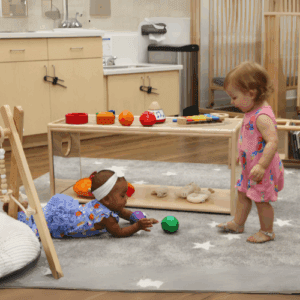
- Plays near (but not really with) other children; this is called parallel play
- Hands a toy to an adult to share or show it
- Points at things to get your attention
- Waves goodbye and enjoys simple social games like peek-a-boo
At this stage, other kids are fascinating but mostly objects of curiosity, not true playmates. Your child may approach another toddler and just stare. That’s fine. The social brain is watching and learning.
18 to 24 Months
- Becomes aware of other children’s feelings and may pat or hug an upset peer
- Begins to imitate other children’s play
- Engages in brief back-and-forth interactions, like rolling a ball
- Experiences strong separation anxiety in new settings
- Begins to show possessiveness over toys (“mine!”)
- May show aggression (hitting, biting) when frustrated; language hasn’t caught up yet
Parallel play is still the norm here, but your toddler is starting to direct their play toward others. You’ll see them begin to mimic what a peer is doing, building a tower because another child is building one. This is meaningful social engagement, even if it doesn’t look like “playing together.”
2 to 3 Years
- Plays alongside and increasingly with other children
- Begins to show preference for specific playmates
- Can wait briefly for a turn (with reminders)
- Understands “my turn, your turn” in simple games
- Uses words more to express wants, though hitting and grabbing still happen
- Shows concern for upset friends (“Are you okay?”)
- May begin to show early signs of friendship by seeking out a specific child
This is a big leap. Two-year-olds are still very much in their own worlds, but three-year-olds are starting to negotiate, plan pretend play together, and develop real preferences for specific kids. If your child has a “best friend” at preschool, this is when that starts.
Wondering if your 2-year-old is on track? See our guide to preschool readiness signs.
3 to 4 Years
- Engages in cooperative play, including shared pretend games with roles and rules
- Negotiates conflicts with words more often (sometimes)
- Develops distinct friendships with preferred peers
- Begins to understand fairness (“That’s not fair!”)
- Can follow simple game rules
- Shows growing ability to wait, share, and compromise
- May exclude others from play (“You can’t play with us”), which is painful but developmentally normal
Pretend play becomes richly social at this age. Kids create elaborate scenarios together: “You be the baby, I’ll be the mama.” They assign roles, negotiate scripts, and manage the story together. This kind of play is one of the most sophisticated social behaviors children do, and it’s where you’ll really see friendships deepen.
4 to 5 Years
- Sustains cooperative play over longer periods
- More flexible about rules and roles in games
- Talks about friends by name and shows genuine interest in their wellbeing
- Can resolve some conflicts independently
- Begins to understand loyalty and exclusion as social concepts
- Shows early capacity for forgiveness and repair
- Adjusts behavior based on social context (quieter in a library, louder on a playground)
By the time children approach kindergarten, friendships are real and meaningful. These relationships have continuity: kids remember what they did together yesterday, share inside jokes, and express genuine upset when a friend is absent. That’s a long way from parallel play at 14 months.
When Do Toddlers Really Start Making Friends?
True friendship, where two children seek each other out, feel connected, and miss each other, typically emerges between ages 3 and 4. But the seeds get planted much earlier.
Researchers describe a progression that looks like this:
- Interest in peers (12-18 months): children watch and approach other kids
- Social play (18-30 months): brief exchanges, imitation, and parallel-then-associative play
- Preferred playmates (2.5-3.5 years): consistent preference for specific kids
- Reciprocal friendship (3.5-5 years): mutual preference, shared history, and emotional connection
The timing varies by temperament. Highly social children may form attachments to peers earlier. More cautious or introverted children may take longer to warm up but form equally deep friendships once they do. Neither is a problem.
What Gets in the Way of Social Development?
A few things can slow or complicate social milestone progression:
Limited Peer Experience
Children who spend most early years at home with adults may lag in peer social skills simply because they’ve had less practice. This typically catches up quickly once they enter group care or preschool. It is not a disorder; it’s a matter of experience.
Language Delays
Social interaction depends heavily on communication. When a toddler can’t find words fast enough, frustration builds and often comes out physically: hitting, grabbing, biting. Addressing language and cognitive development alongside social skills matters. Speech therapy can help when delays are significant.
Dysregulation
A child who can’t yet manage their own emotions will struggle to navigate social situations. Before a toddler can be a good friend, they need enough self-regulation to not fall apart when things don’t go their way. This develops through co-regulation with trusted adults, which is exactly why quality caregiver relationships matter so much in early childhood.
Anxiety or Sensory Sensitivities
Some children find busy, noisy group settings overwhelming. They may withdraw not because they don’t want friends, but because the environment is hard for them to process. Quieter, smaller group settings and gradual exposure can help significantly.
Looking for a toddler program that supports social development? Schedule a tour at Strong Start to learn more about our approach.
How Parents Can Support Social Milestones at Home
You don’t need to engineer a social curriculum. Small, consistent things make a big difference.
Name Feelings (Yours and Theirs)
“You’re frustrated that Mia took the crayon. That makes sense.” “I felt sad when my friend canceled plans. Sad feelings are hard.” This emotional labeling, which researchers call “emotion coaching,” is one of the most evidence-backed things parents can do. Kids who hear feelings named regularly get better at reading emotions in themselves and others, which is the bedrock of friendship.
Arrange Low-Stakes Playdates
One child at a time. Short duration (60-90 minutes for toddlers). A familiar, comfortable setting. Structured activities for younger kids. Give kids space to play but stay close enough to coach if needed. The goal isn’t a flawlessly smooth playdate; it’s practice.
Don’t Rush the Sharing Script
Forced sharing (“give it to her right now”) doesn’t teach generosity. It teaches resentment and anxiety. A better approach: “In a few minutes, it’ll be her turn.” Then follow through. Waiting is a skill. Children can learn it, but it takes time and consistency, not just demand.
Narrate Social Situations
When you’re at the playground: “That boy looks like he wants to play too. What do you think he’s feeling?” When conflicts arise: “What happened? How do you think she felt when you grabbed that?” This social narration builds what researchers call “theory of mind,” the ability to understand that other people have their own thoughts and feelings. It typically clicks around age 3-4 and changes everything about how children interact.
Read Books About Friendship
Children’s picture books about friendships, conflicts, and feelings give kids language and frameworks for social situations. Favorites: “Enemy Pie,” “Each Kindness,” “Big Al,” “The Invisible String.” Reading and discussing these stories gives kids a safe space to think about social dynamics before they’re in them.
The Role of Quality Early Childhood Programs
Group childcare and preschool, done well, are among the most powerful things you can offer a toddler’s social development. But quality matters enormously.
High-quality early childhood environments do specific things:
- Small groups and low ratios, so children actually get to connect with each other and with teachers
- Consistent caregivers, so children feel secure enough to take social risks
- A social-emotional curriculum that explicitly supports friendship skills, conflict resolution, and emotional literacy
- Play-rich environments where children have extended time for the kind of cooperative play that builds real friendships
At Strong Start, our toddler classrooms are built around these principles. Our educators use a Reggio Emilia-inspired approach that centers child relationships alongside academic milestones. Our social-emotional curriculum is woven into every part of the day, from morning meeting to outdoor play to transitions.
Want to see how a Reggio Emilia classroom supports your toddler’s social growth? Schedule a tour at Strong Start and see our approach in action.
When to Talk to Your Pediatrician
Most variation in social development is normal. But a few signs are worth discussing with your child’s doctor or a developmental specialist:
- No interest in other children by 18 months
- No pointing to show you things by 14 months
- No imitation of others by 18 months
- No back-and-forth play by 2 years
- Significant regression in social skills that were previously present
- Extreme difficulty with peer settings that worsens over time, not just at the start
Early intervention for social communication challenges is highly effective, especially before age 5. If something feels consistently off, don’t wait and see. Early support makes a real difference.
Frequently Asked Questions
At what age do toddlers start making friends?
Most toddlers develop genuine, reciprocal friendships between ages 3 and 4. Before that, they show interest in peers and preferred playmates, but true friendship with mutual preference, shared history, and emotional connection typically emerges in the preschool years.
Is parallel play normal for toddlers?
Yes. Parallel play (playing near another child without directly interacting) is completely normal and developmentally appropriate from about 12 months through age 3. It’s not antisocial. Children are watching, learning, and building comfort with peers through parallel play.
Why does my toddler hit other kids?
Toddlers hit when their language hasn’t caught up to their frustration. They want something, can’t communicate it, and act physically. This is developmentally normal through about age 3, though it needs to be addressed consistently. Teaching emotional vocabulary and giving toddlers words for big feelings helps decrease it over time.
Should I be worried if my toddler doesn’t seem interested in other kids?
A lack of interest in other children before 18 months isn’t unusual, especially for introverted or slow-to-warm-up children. After 18 months, some interest in peers is expected. If a toddler shows no interest in other children and isn’t pointing or engaging socially with adults either, it’s worth mentioning to your pediatrician.
How can I help my toddler make friends at preschool?
Name their new classmates by name at home. Ask open-ended questions: “What did you and Jayden do today?” Arrange a playdate outside of school with a child they seem comfortable with. Read books about friendship. And give it time: most kids take weeks or months to settle into new social environments.
Written By
Marc Hoffman
Founder, Strong Start Early Care & Education
Marc founded Strong Start in 2014, inspired by his studies at Williams College, Yeshiva University, and research at Yale University. His child-centered, inquiry-based approach to early education has helped hundreds of families in the Trumbull and Bridgeport communities. As a parent himself, Marc understands the importance of finding a nurturing environment where every child can learn, grow, and flourish.