The search for the perfect child care program can feel like a second job. You’re balancing schedules, comparing costs, and trying to get a feel for a place in a short 30-minute tour. How do you know what really matters? It helps to have a clear checklist of non-negotiables. Before you fall in love with a particular curriculum or a beautiful playground, it’s crucial to confirm that the foundational pieces are in place. This includes everything from health and safety protocols to the way teachers interact with children. We’ve created this guide to give you that confidence, helping you spot the key indicators of a premier learning and educational daycare so you can make a choice that feels right for your entire family.
Key Takeaways
- Understand the “Why” Behind the Day: A true early learning center is defined by its educational philosophy. Prioritize programs with an intentional curriculum that supports whole-child development, turning daily activities into meaningful learning experiences rather than just filling time.
- Focus on the Educators and the Environment: The quality of a program depends on its teachers and the classroom itself. Look for qualified, passionate educators, low teacher-to-child ratios, and a physical space that is thoughtfully designed to inspire curiosity and exploration.
- Seek a Partnership and Proof of Quality: The right program will feel like a team effort between you and the school. Look for centers that emphasize open communication and parent involvement, and use markers like NAEYC accreditation to confirm a commitment to the highest standards.
What’s the Difference Between Daycare and an Early Learning Center?
When you start looking for childcare, you’ll likely hear the terms “daycare” and “early learning center” used almost interchangeably. While both provide a safe place for your child while you’re at work, their core philosophies and goals can be quite different. Understanding this distinction is the first step in finding a program that truly aligns with what you want for your child’s first school experience.
A daycare’s primary role is often custodial—to keep children safe, fed, and supervised. An early learning center does all of that, but its mission is rooted in education. It’s a place built on a deep understanding of child development, where every activity and interaction is an opportunity for learning. Think of it as the difference between babysitting and teaching. Both are valuable, but one is intentionally designed to prepare your child for kindergarten and a lifetime of curiosity. This approach shapes everything from the classroom design to the daily schedule, creating a rich environment where children don’t just spend their day; they invest it in growth.
Going Beyond Basic Care
The most significant difference lies in the program’s purpose. Daycare centers focus primarily on keeping children safe and busy, while early childhood education centers are built on teaching, child development, and helping children learn new skills. At an early learning center, the goal isn’t just to fill the hours of the day; it’s to fill those hours with meaningful experiences that spark curiosity and build confidence.
This shift in focus changes everything, from the daily schedule to the way educators interact with children. Instead of simply supervising play, our exceptional educators are active participants, guiding discovery and asking questions that encourage deeper thinking. They are trained professionals who understand the milestones of early childhood and know how to create activities that support them.
A Focus on Whole-Child Development
An early learning center sees your child as a whole person, not just a mind to be filled with facts. Early Childhood Education Centers have set lesson plans (a curriculum) that help children grow in thinking, social skills, feelings, and physical abilities. This comprehensive approach ensures that children are not only academically prepared for kindergarten but are also socially and emotionally ready for the classroom environment.
This focus on whole-child development means we pay just as much attention to learning how to share and express feelings as we do to recognizing letters and numbers. The curriculum is woven into every part of your child’s day, from circle time to outdoor play. It’s a balanced approach that nurtures every aspect of your child’s growth, helping them become capable, well-rounded little learners.
A Purposeful Learning Environment
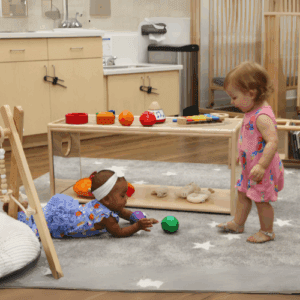
Walk into an early learning center, and you’ll notice that the environment itself feels different. The space is intentionally designed to be a “third teacher,” inviting exploration and discovery at every turn. Educational philosophies like Reggio Emilia emphasize inquiry and child-led learning, creating environments that are nurturing, stimulating, and developmentally appropriate for each age group.
From the layout of the preschool classrooms to the materials on the shelves, everything is chosen with a purpose. You’ll see natural materials, open-ended toys that encourage imagination, and displays of the children’s own work, showing them that their ideas are valued. This creates a vibrant, engaging atmosphere where children feel empowered to ask questions, solve problems, and take the lead in their own learning journey.
Inside the Classroom: Common Educational Approaches
When you peek into a high-quality early learning center, you’ll see more than just playtime. You’ll see a carefully crafted environment where every activity, from building with blocks to digging in a sensory bin, is an opportunity for growth. This is guided by an educational philosophy—a center’s core beliefs about how children learn best. While some schools stick to one specific method, many of the best programs, including ours, draw inspiration from several proven approaches to create a rich, well-rounded experience for every child.
Understanding these philosophies can help you find a program that feels right for your family and your child’s unique personality. It’s not about finding the one “perfect” curriculum, but about recognizing the thoughtful intention behind the daily schedule. You’ll want to see a classroom that encourages curiosity, supports different learning styles, and helps children develop socially and emotionally, not just academically. When you see educators who are passionate about their approach and can explain why they do what they do, you know your child is in a place where their development is the top priority. Let’s look at a few of the most respected and effective approaches you’ll find in today’s early learning centers.
Learning Inspired by Reggio Emilia
The Reggio Emilia approach views children as strong, capable, and full of potential. Instead of seeing them as empty vessels to be filled with information, this philosophy honors their innate curiosity and intelligence. In a Reggio-inspired classroom, learning is a collaborative adventure between children and teachers. The curriculum isn’t set in stone; it emerges from the children’s own interests. If a child is fascinated by shadows, the teacher will facilitate activities that let them explore light, shape, and reflection. The classroom itself is considered the “third teacher,” intentionally designed with natural light and beautiful materials to provoke wonder and encourage exploration. This is a core part of our Reggio Emilia inspiration at Strong Start.
The Power of Project-Based Learning
Imagine your child and their classmates spending weeks investigating a topic they’re genuinely excited about, like how gardens grow or what happens on a construction site. That’s the heart of the Project Approach. This method turns learning into an in-depth investigation where children’s questions guide the journey. They don’t just learn facts; they become researchers, problem-solvers, and collaborators. Teachers facilitate this process by helping children find answers through hands-on experiments, field trips, and conversations with experts. The Project Approach helps children develop critical thinking skills and a deep, meaningful understanding of the world around them, all while working together with their peers.
Why a Play-Based Curriculum Works
Play is the natural language of childhood, and a play-based curriculum uses it to build a powerful foundation for lifelong learning. This isn’t just unstructured free time. It’s purposeful play, where every station in the classroom—from the dramatic play corner to the block area—is designed to help children develop crucial skills. While they’re pretending to be chefs, they’re building vocabulary and learning to cooperate. When they’re figuring out how to build a tall tower, they’re exploring physics and persistence. This approach fosters a genuine love of learning by allowing children to explore, experiment, and discover at their own pace, making school a place of joy and curiosity.
Integrating STEM and the Arts
The best early education programs understand that learning isn’t divided into neat little boxes. That’s why you’ll often see a seamless blend of STEM (Science, Technology, Engineering, and Math) and the arts. This integrated approach fosters both creativity and critical thinking. A single activity can touch on multiple subjects: building a ramp for a toy car involves engineering and physics, while charting how far the car travels introduces math concepts. Afterward, children might paint with the car’s wheels, turning a science experiment into an art project. Our Enrichment Program is built on this idea, ensuring children develop skills across all domains in a fun, hands-on way.
What to Look for in an Early Childhood Educator
The classroom environment and curriculum are incredibly important, but the heart of any great early learning center is its teachers. These are the people who will guide your child’s daily discoveries, comfort them when they’re sad, and celebrate their every milestone. An educator does so much more than supervise; they create a warm, engaging, and secure atmosphere where your child can truly thrive. When you’re touring a center, pay close attention to the interactions between teachers and children.
Finding the right educator means looking for a unique combination of professional qualifications, a genuine passion for teaching young children, and a commitment to their own growth. A great teacher understands the science behind child development but also knows that every child is an individual with their own personality and pace. As you evaluate different programs, ask about their hiring standards and what they look for in their teaching staff. The best centers are proud to talk about their exceptional educators and what makes them special.
Credentials in Early Childhood Education
When you entrust your child to an educator, you want to know they are a trained professional. Look for teachers with degrees or certifications specifically in early childhood education or a related field. This formal training means they have a deep understanding of child development, learning theories, and how to create a safe and stimulating classroom.
These credentials show that an educator has a professional foundation for their work. They aren’t just passionate about children—they’ve dedicated themselves to learning the best ways to support their growth. This expertise allows them to design thoughtful activities that are not only fun but also build critical cognitive, social, and emotional skills for your child.
A Commitment to Ongoing Training
The field of early childhood education is always evolving as new research gives us a better understanding of how children learn. Because of this, a great educator’s learning journey doesn’t stop after they get their degree. The best teachers are lifelong learners who are committed to staying current on the latest practices in child development, health, and safety.
Ask the center’s director about their requirements for ongoing professional development. At Strong Start, our educators receive regular training to refine their skills and learn new strategies for supporting the children in their care. This commitment ensures that your child is benefiting from the most up-to-date, effective, and caring teaching methods available. This dedication to growth is a key part of our NAEYC accreditation.
Experience with Your Child’s Age Group
The needs of an infant are vastly different from the needs of a four-year-old. An educator who is a master at guiding toddler explorations might use a completely different set of skills than one who excels at preparing preschoolers for kindergarten. That’s why it’s so important to find a teacher with specific, hands-on experience with your child’s age group.
An experienced teacher understands the specific developmental milestones and challenges for that stage. They know how to set up an environment that is both safe and appropriately challenging, whether it’s for a baby learning to crawl in our infant classrooms or a curious preschooler asking complex questions. This specialized experience ensures your child gets the right kind of support at the right time.
Understanding the Investment in Early Education
Thinking about the cost of child care is a big part of choosing the right program for your family. It’s more than just a monthly expense; it’s an investment in your child’s future. High-quality early learning centers put tuition toward creating a safe, nurturing, and stimulating environment where children can thrive. This includes everything from hiring and retaining exceptional educators with degrees in the field to maintaining low teacher-to-child ratios and providing high-quality learning materials. While the price tag can seem high, studies show that every dollar invested in high-quality early learning can yield significant returns in a child’s long-term development and success.
What Influences the Cost?
Several key factors determine the tuition at an early learning center. The age of your child is a primary one, as infant and toddler programs require more one-on-one attention and lower staff-to-child ratios, making them more expensive. The qualifications and experience of the teachers also play a significant role; centers that invest in degreed educators and ongoing professional development will reflect that in their pricing. The curriculum, enrichment programs, and the quality of the facility itself—including safety features and learning materials—all contribute to the overall cost. It’s helpful to see tuition not just as paying for supervision, but for a comprehensive educational experience.
Exploring Tuition and Payment Options
When you start looking at numbers, it’s important to have a clear picture of what’s included. The true cost of high-quality child care can be a significant part of a family’s budget. Many centers offer different payment schedules, and some may have options for families who need support. It’s always a good idea to ask about any available tuition benefits or assistance programs. Don’t hesitate to have an open conversation with the center’s director about tuition, billing cycles, and any potential fees. They can walk you through the specifics and help you understand exactly what your investment covers, ensuring there are no surprises down the road.
Why It’s a Worthwhile Investment
Choosing an early learning center is one of the first major decisions you’ll make for your child’s education. While the financial commitment is real, the long-term benefits are immeasurable. A quality program provides a foundation for social, emotional, and cognitive development that prepares children for kindergarten and beyond. Hearing from other parents can also provide valuable insight. When you read testimonials from families who have seen their children blossom in a particular environment, it helps put the cost into perspective. Seeing what families are saying can affirm that you’re not just paying for a service, but investing in a community and a strong start for your child.
Your Checklist for Choosing the Right Program
Walking into a potential early learning center for the first time can feel overwhelming. You’re not just looking for a place for your child to spend their days; you’re searching for a community that will nurture their curiosity, keep them safe, and partner with you in their growth. To help you feel confident and prepared, think of your search as a checklist. By focusing on a few key areas, you can cut through the noise and find a program that truly aligns with your family’s values and your child’s needs.
This checklist covers the non-negotiables—the foundational elements that separate a good program from a great one. We’ll touch on everything from the tangible aspects, like the physical environment and safety protocols, to the relational components, like the partnership between parents and teachers. It’s also important to look for external markers of quality that show a center is committed to the highest standards. Use these points as a guide during your tours and conversations. They’ll help you ask the right questions and observe the details that matter most, ensuring you find a place where your child will not just be cared for, but will truly thrive.
Prioritizing Health and Safety
Before you look at any curriculum or classroom setup, your first priority should always be your child’s well-being. A top-tier program will have clear and comprehensive health and safety protocols that are visible from the moment you walk in. Ask about their policies for illness prevention, cleanliness, and emergency preparedness. Look for secure entrances, clean play areas, and staff who are attentive to the children’s needs. This focus on safety creates the secure environment your child needs to feel comfortable enough to explore, learn, and grow with confidence. It’s the foundation upon which all great learning experiences are built.
The Importance of Low Teacher-to-Child Ratios
A low teacher-to-child ratio is one of the most critical indicators of a high-quality program. When educators are responsible for fewer children, they can provide more individualized attention, form stronger bonds, and respond more thoughtfully to each child’s unique needs and cues. This is especially vital in infant classrooms, where responsive caregiving is essential for development. Ask about the specific ratios for your child’s age group and observe the interactions in the classroom. Smaller group sizes foster a calmer, more engaging atmosphere where children receive the personal support they need to feel seen and understood.
Classrooms Designed for Learning
Take a close look at the physical environment. Is it just a room with toys, or is it a space intentionally designed for learning? A great classroom should be nurturing, stimulating, and developmentally appropriate. Look for well-organized learning centers, materials that are easily accessible to children, and displays of the children’s own artwork and project work. The environment should act as a “third teacher,” thoughtfully arranged to encourage exploration, independence, and collaboration. The setup of the preschool classrooms, for example, should reflect a balance of child-led discovery and teacher-guided activities.
A Strong Parent-Teacher Partnership
You are your child’s first and most important teacher, and the right program will honor that. Look for a school that values partnering with parents and prioritizes open, consistent communication. How do they share updates about your child’s day? Are there opportunities for you to get involved and connect with educators? A true partnership means you work together as a team to support your child’s development. This collaborative relationship ensures consistency between home and school, creating a strong support system that helps your child feel secure and understood in every aspect of their life.
Look for NAEYC Accreditation
When you’re comparing programs, look for a key marker of excellence: accreditation from the National Association for the Education of Young Children (NAEYC). This isn’t just a certificate on the wall; it’s proof that a center has voluntarily undergone a rigorous process to meet the highest national standards for early childhood education. NAEYC Accreditation means the program excels in areas like curriculum, teacher qualifications, health and safety, and family partnerships. Choosing an accredited school gives you peace of mind, knowing it is committed to providing an exceptional and research-based educational experience for your child.
The Real-World Benefits: What Other Parents See
While tours and curriculum guides are essential, nothing speaks louder than the experiences of other families. Hearing directly from parents whose children have attended a program gives you a real-world glimpse into its impact. It’s how you learn about the small moments of connection and the big leaps in development that don’t always show up in a brochure. This feedback is one of the most powerful tools you have for finding a place that will truly feel like a second home for your child.
What Parents Value Most
When you read through reviews, you’ll notice that parents often focus on the feeling of trust and partnership. They value educators who are loving, attentive, and genuinely invested in their child’s well-being. For many parents, online reviews are just as influential as personal recommendations from friends. Seeing consistent praise for a school’s warm environment and dedicated staff provides powerful reassurance. It shows that a center doesn’t just care for children, but that it also supports and partners with families. You can see what our families are saying to get a better sense of the community we’ve built together.
The Positive Changes Parents Notice
One of the most rewarding parts of finding the right early learning center is seeing the positive changes in your child. Parents often share stories of their once-shy toddler blossoming into a confident friend-maker, or their preschooler suddenly explaining complex ideas they explored in class. This growth happens when children are in an environment where they feel safe, seen, and encouraged to be curious. When you hear parents talk about teachers who “just get” their child’s unique personality, you know you’ve found a place with exceptional educators who are skilled at nurturing individual potential and sparking a genuine love for learning.
Building a Foundation for School Success
Choosing a high-quality early education program is one of the best investments you can make in your child’s future. The benefits extend far beyond kindergarten readiness. A curriculum inspired by proven philosophies like the Reggio Emilia approach is designed to teach children how to learn. It builds critical thinking skills, creativity, and a sense of curiosity that will serve them throughout their lives. This strong foundation is why experts emphasize the incredible long-term value of early learning, noting that it prepares children for academic success and helps them develop into capable, well-rounded individuals.
Related Articles
- daycare center – Strong Start Early Care and Education
- preschool & day care center – Strong Start Early Care and Education
- A Parent’s Guide to an Early Childhood Education Center – Strong Start
Frequently Asked Questions
Is an “early learning center” just a fancier name for daycare? Not at all. While both provide care, the core purpose is different. Think of it this way: a traditional daycare focuses on keeping your child safe and supervised while you’re away. An early learning center does that too, but its primary goal is education. Every part of the day, from playtime to snacks, is intentionally designed by trained educators to help your child develop specific social, emotional, and cognitive skills.
My child is very shy. How does a play-based or project-based approach work for quieter kids? These approaches are wonderful for children with all types of personalities, especially those who are more reserved. Instead of forcing participation in large group activities, these methods allow children to engage at their own comfort level. A quieter child can contribute to a project by observing, drawing, or building, finding their voice in a small group setting. The focus is on following their interests, which helps build their confidence naturally.
What’s the most important thing to pay attention to when I tour a school? Look past the shiny toys and colorful bulletin boards and focus on the interactions. How do the teachers speak to the children? Do they kneel to get on their level and listen with genuine interest? Do the children seem happy, relaxed, and comfortable approaching the adults? The warmth and quality of those relationships between educators and children will tell you more about a program than anything else.
Why is care for infants and toddlers often more expensive than for preschoolers? It really comes down to providing the safest and most responsive care. Babies and toddlers require much more one-on-one attention to thrive. To ensure this, high-quality centers maintain very low teacher-to-child ratios, which means more staff are needed for fewer children. This specialized, attentive care is essential for their development and is the biggest factor in the cost difference.
How will I know what my child is actually doing and learning all day? A great program will make communication a top priority because they see you as a partner. You should expect to receive consistent updates about your child’s day, whether it’s through a parent communication app with photos and notes, daily reports, or simply having teachers who are available for a quick chat at pickup. You should never feel like you’re in the dark about your child’s experiences.