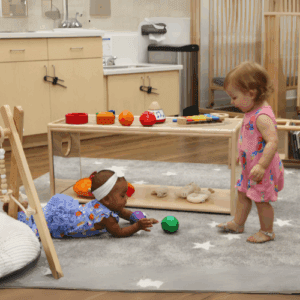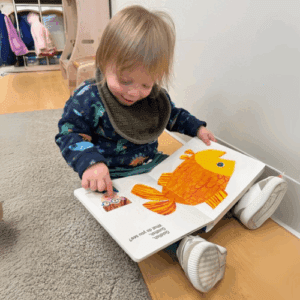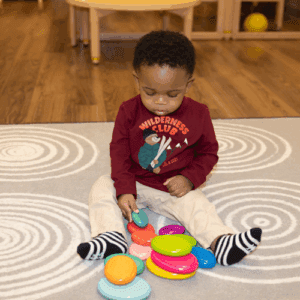

At Strong Start Early Care & Education, we believe that children are not just ‘sponges’ waiting to be filled with facts; they are natural investigators. Our Inquiry-Based Learning (IBL) model, central to our Reggio Emilia-inspired curriculum, turns the traditional classroom model on its head. Instead of a teacher-led lecture, our classrooms in Trumbull and Shelton prioritize child-centered discovery. By meeting children where they are developmentally, we foster a lifetime of intellectual curiosity and critical thinking.
Meeting a child where he or she is developmentally is the surest way to encourage and promote a lifetime of intellectual curiosity. The journey begins with the child’s own interests, be that insects and airplanes or fairy houses and dinosaurs. Forcing a child to learn what they don’t want to can be counterproductive. Children need to learn that their intrinsic urge to learn is rewarded. Studies show that intrinsic motivation is a far better indicator of success that being able to to respond to extrinsic motivation. We’ll be sure to come back to this topic in the future as well.
The Teacher as a Facilitator and Co-Learner
In a traditional setting, a teacher provides answers. In our Pre-Kindergarten and Preschool classrooms, the teacher provides questions.
-
Observational Learning: Teachers watch how children interact with materials to identify their interests.
-
Scaffolding: Once an interest is identified—like how water flows or how shadows move—teachers provide the tools and ‘provocations’ to help the child find the answer themselves.
-
Documentation: We document these journeys of discovery, allowing parents to see the fine motor skills and cognitive growth happening in real-time.
Building Problem-Solvers for the Future
Inquiry-based learning is more than just ‘fun’—it is a rigorous academic foundation. When children lead their own learning, they develop:
-
Advanced Vocabulary: Learning terms like ‘hypothesis’ and ‘observation’ through hands-on experience.
-
Resilience: Learning that ‘mistakes’ are simply more data points in an experiment.
-
Social Collaboration: Working with peers to solve a shared question, which is a core component of emotional intelligence.
The first step in inquiry-based learning is to let the ask questions. Some children will have to be prompted at first. We have to teach them to put their ‘wonderings’ into words. The questions can be simple. ‘How does it work?” “How does it move?” “How do we know that?” But the process of finding the answers teaches them how to learn. We’ll go through the next steps in future blogs. Be sure to check back and in the meantime call and set up a tour of our early care and education center. Inquiry-based learning is the cornerstone of the Strong Start experience. If you want to see how this child-centered approach prepares your child for the transition to kindergarten, we invite you to visit our campuses. Schedule a tour at our Trumbull or Shelton locations today to see inquiry-based learning in action.
Written By
Marc Hoffman
Founder, Strong Start Early Care & Education
Marc founded Strong Start in 2014, inspired by his studies at Williams College, Yeshiva University, and research at Yale University. His child-centered, inquiry-based approach to early education has helped hundreds of families in the Trumbull and Bridgeport communities. As a parent himself, Marc understands the importance of finding a nurturing environment where every child can learn, grow, and flourish.